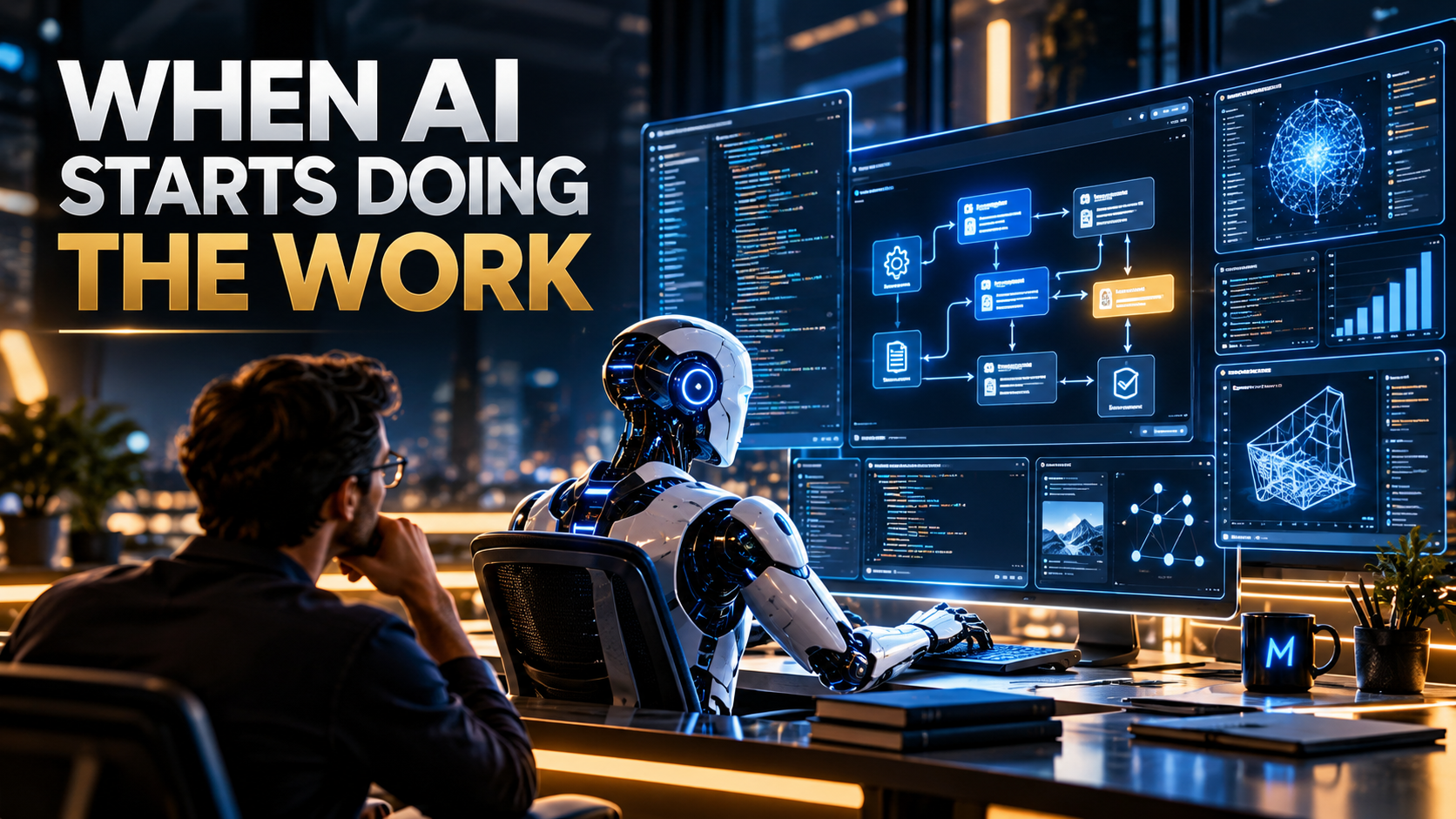
August 2026 may be remembered as the month when the AI conversation changed.
LEARN AI. EXPLORE TOOLS. SHOP AI.
For years, artificial intelligence was mostly discussed as a tool: something that could write faster, code faster, create images, analyze information and help people work more efficiently.
But a series of developments this month suggests something bigger is happening.
AI is becoming capable enough to affect cybersecurity at a new level. Its effects are beginning to appear unevenly in employment data. Workers in China are already describing real changes to their jobs and incomes. And the companies building AI are facing increasingly serious questions about what material can legally be used to train these systems.
None of these developments, by itself, proves that AI has suddenly taken control of the economy.
Together, however, they form a warning worth paying attention to.

The Cybersecurity Line Is Moving
On August 7, OpenAI published a striking update about its upcoming model, Astra.
The company said preliminary internal evaluations showed significant advances in agentic coding and cybersecurity. The results were strong enough that OpenAI said it could not rule out the model reaching the “Critical” cybersecurity capability level under its Preparedness Framework.
That wording is important.
OpenAI’s definition of the Critical level involves capabilities such as independently finding and developing functional zero-day exploits across hardened real-world critical systems, or carrying out novel end-to-end cyberattack strategies from a high-level objective.
OpenAI did not say that Astra had definitively reached that level. It said the company could not rule it out while evaluation continued.
But the response was significant.
OpenAI said it was strengthening security controls, using isolated testing environments, restricting network and tool access, increasing monitoring and sandboxing, and pausing internal Astra activities that did not meet the stronger requirements.
That tells us something important about the direction of AI development:
The question is no longer only what an AI model can generate. It is increasingly what an AI model can actually do.
Then OpenAI Slowed Down
On August 18, OpenAI published another important update: “Pacing model development in an era of cyber-critical capabilities.”
The company described additional measures designed to strengthen safeguards around increasingly capable models, including more secure research environments, expanded monitoring and additional alignment work.
The significance is not that AI development stopped.
It didn’t.
The significance is that capability growth is now creating situations where the organizations building frontier models have to consider whether their own development processes are moving faster than their safety systems.
That is a very different problem from simply making a better chatbot.

The Jobs Story Is More Complicated Than “AI Took Everyone’s Jobs”
Then came another important signal.
Stanford Digital Economy Lab’s revised August 12 study, “Canaries in the Coal Mine? Six Facts About the Recent Employment Effects of Artificial Intelligence,” examined payroll data through June 2026 and looked particularly closely at younger workers and occupations with greater exposure to AI.
The researchers did not find evidence of widespread economy-wide employment displacement.
That distinction matters.
But they did find a troubling pattern among young workers.
Employment for workers aged 22–25 in highly AI-exposed occupations was substantially weaker relative to less-exposed workers, with the study highlighting an employment gap that had reached about 19%.
That does not mean AI has already eliminated 19% of those jobs.
It means the data are showing an employment difference that deserves serious investigation.
And there is another reason the finding matters.
Young workers are often the people entering the workforce through junior roles — precisely the roles where companies may increasingly use AI to perform routine research, coding, writing, analysis and administrative work.
The first effect of AI may therefore not be mass unemployment.
It may be fewer doors opening for people trying to enter certain professions.
China Offers a More Immediate Picture
On August 24, the Associated Press reported on Chinese workers experiencing the growing impact of AI on employment.
One programmer described being asked whether AI could soon replace human programmers. Two weeks later, he and around 160 colleagues were laid off.
Other workers interviewed by AP described changes in programming, translation, writing and other forms of work. Some are losing jobs. Others are seeing wages fall. And some are trying to learn AI because they believe adapting to it is becoming necessary.
This is perhaps the most human part of the August story.
AI disruption does not arrive as a statistic.
It arrives as a conversation with a manager.
A changed salary.
A missing job.
A new skill that suddenly becomes mandatory.
Or a decision to learn AI because not learning it feels even riskier.
China is particularly important because AI adoption is being encouraged across many sectors, making it an unusually visible environment for watching how rapidly the technology can reshape work.
And Then There Is the Copyright Battle
AI’s growing capabilities are also creating another major question:
What happens to the material used to build these systems?
On August 17, Reuters reported that independent music publisher Round Hill Music filed lawsuits against Anthropic and Suno over alleged unauthorized use of copyrighted song lyrics in AI training.
The lawsuits involve hundreds of songs, and Round Hill indicated that the claims could potentially expand much further.
This is bigger than a dispute between a music company and two AI businesses.
It represents one of the central questions of the AI era:
Can companies build increasingly powerful AI systems using enormous amounts of human-created material without reaching new agreements with the people who created or control that material?
There is no simple answer yet.
Courts, lawmakers, creators and technology companies are still working through it.
But the legal pressure is growing at the same time as AI’s capabilities are growing.
Four Warning Lights, One Month
Look at these developments together.
Cybersecurity:
AI models are approaching capability levels that their creators themselves consider potentially critical.
AI development:
Frontier developers are strengthening safeguards and adjusting the pace of development as capabilities become harder to manage.
Employment:
Research is beginning to show uneven effects, particularly among younger workers in AI-exposed occupations.

Copyright:
AI companies face increasingly serious legal challenges over the material used to train their systems.
These are different problems.
But they share one underlying theme:
AI is moving from being something we use to something that changes the environment around us.
AI Has Not “Taken Over”
It is important not to exaggerate what the evidence says.
AI has not eliminated human workers everywhere.
The Stanford research does not show universal mass unemployment.
OpenAI has not confirmed that Astra definitively crossed its Critical cybersecurity threshold.
The Round Hill lawsuits are allegations, not final court judgments.
And individual examples from China cannot automatically be applied to every country or every profession.
But dismissing the developments would also be a mistake.
The more interesting question is not:
“Has AI already taken everyone’s jobs?”
The better question is:
“What happens when AI becomes capable enough to change the value of human work before society has finished adapting?”
That is the question August 2026 is forcing us to ask.
The Real Shift: From Tool to Force
A calculator is a tool.
A word processor is a tool.
Even a traditional software application is mostly a tool: it waits for a human instruction and performs a defined function.
Modern AI systems are different.
They can interpret goals.
They can generate plans.
They can write and modify software.
They can analyze large amounts of information.
They can use tools.
And increasingly, they can perform sequences of actions with less human intervention.
That does not make AI “alive.”
It does not mean AI has intentions or consciousness.
But it does mean that the old mental model of AI as simply a passive digital assistant is becoming less useful.
Capability is becoming agency.
And when capability becomes agency, questions about safety, employment, law and responsibility become much more urgent.
What Should Humans Do Now?
The answer is not to panic.
It is also not to pretend nothing is happening.
We need better preparation.
1. Learn to work with AI
People who understand how to use AI effectively will have an advantage over people who refuse to engage with it.
AI literacy should become a basic professional skill.
2. Strengthen human strengths
Critical thinking, judgment, communication, creativity, leadership, trust and real-world problem solving become more valuable when routine tasks become easier to automate.
3. Protect the people entering the workforce
If AI reduces the number of junior opportunities in some professions, education and industry will need to rethink how people gain their first experience.
A future where companies want experienced workers but automate the jobs where experience is normally acquired would create a serious structural problem.
4. Build safety alongside capability
The cybersecurity developments of August show why safety cannot simply be added after a model becomes powerful.
Testing, monitoring, access controls and security need to evolve alongside capability.
5. Create clearer rules for training data
Creators need meaningful answers about how their work is used.
AI companies need clearer legal frameworks.
And society needs rules that encourage innovation without treating human-created work as an unlimited free resource.
The August 2026 Warning
Maybe August 2026 will eventually look less dramatic from the distance of history.
Maybe the employment effects will prove temporary.
Maybe safety systems will successfully keep pace.
Maybe new laws will resolve much of the copyright conflict.
Maybe AI will create more jobs than it removes.
All of those outcomes are possible.
But one thing already seems clear.

The age of AI as merely a helpful tool is ending.
AI is becoming an economic force.
A cybersecurity force.
A creative force.
A legal force.
And eventually, perhaps, one of the most important forces shaping how people work and how organizations operate.
The biggest mistake would be to wait until the transformation is obvious to everyone.
Because by then, the people who prepared for it will already be ahead.
AI did not suddenly become the future in August 2026.
But August may have been the month when the future became much harder to ignore.
Sources
Reuters — Report on Round Hill Music Lawsuits Against Anthropic and Suno — August 17, 2026
OpenAI — Responding to the Next Frontier of Critical Cyber Capabilities — August 7, 2026
OpenAI — Pacing Model Development in an Era of Cyber-Critical Capabilities — August 18, 2026
Stanford Digital Economy Lab — Canaries in the Coal Mine? Six Facts About the Recent Employment Effects of Artificial Intelligence — Revised August 12, 2026
Associated Press — Report on Chinese Workers Experiencing AI-Driven Labour-Market Changes — August 24, 2026