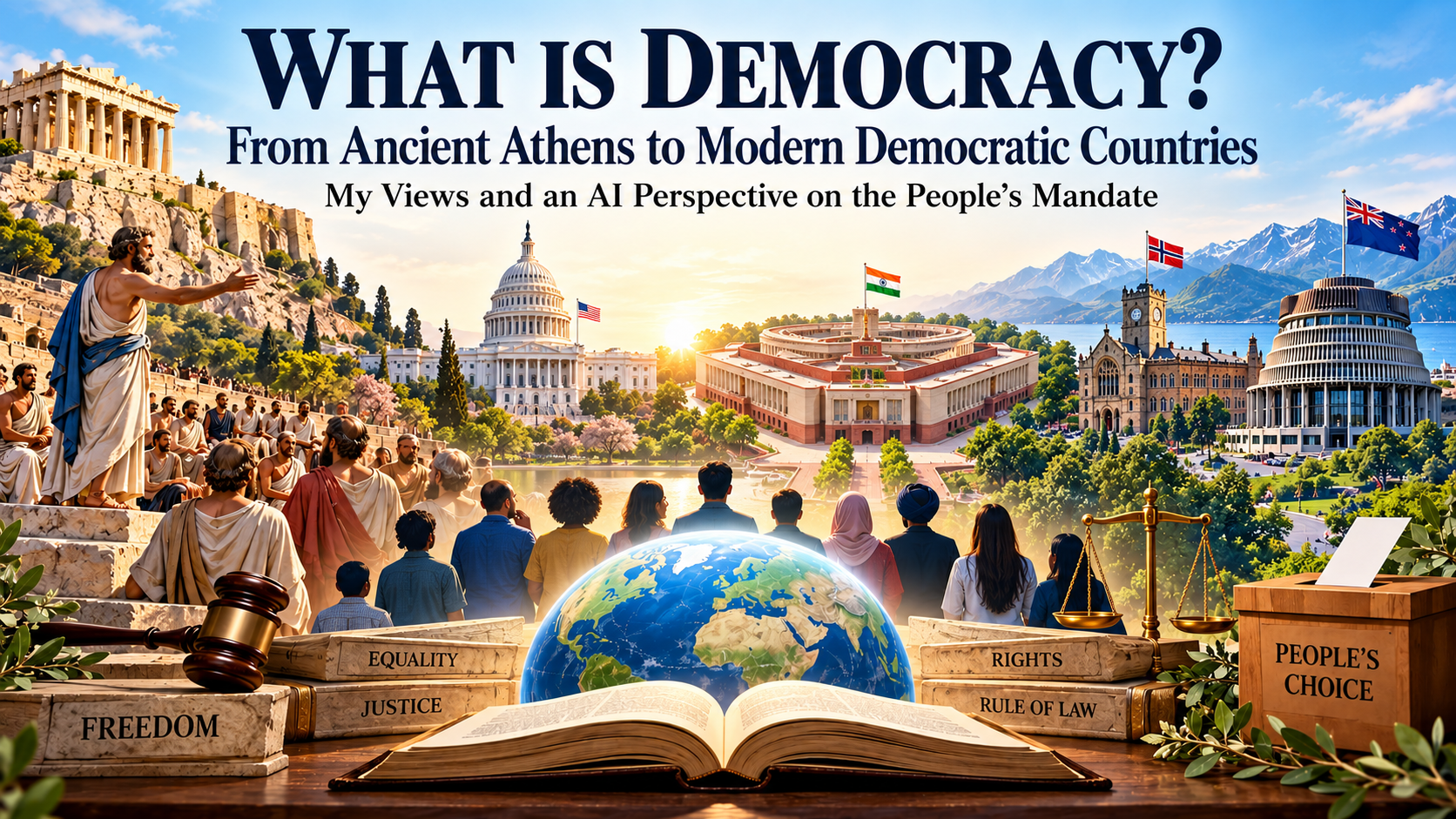
From Ancient Athens to Modern Democratic Countries: My Views and an AI Perspective on the People’s Mandate
Democracy means choosing our leaders, protecting our freedoms, respecting the law, and resolving disagreements peacefully. It gives people the power to elect their government, question its decisions, and change it through free and fair elections. But democracy is not simply the rule of the majority; it also protects individual rights and ensures that no one is above the law.
The people’s mandate is not the mob’s mandate.

Introduction:
Who Should Govern a Country?
Who should have the right to govern a country? A king who inherits power? A military leader who takes power by force? A religious authority who claims the right to rule? Or the people, through their votes?
My answer is clear:
Democracy is the best general system of governing a country because it gives people a voice and makes those in power answerable to them.
Democracy does not guarantee a perfect government. People can elect poor leaders, and governments can fail. But democracy gives citizens peaceful ways to question their leaders, demand change, and choose a new government.
This makes democracy valuable to every country, whatever its history, culture, language, or religion. People may follow different faiths or no religion at all. They may hold different political views. Yet all should enjoy equal rights and equal respect under the law.
Democracy does not require everyone to think alike. It requires us to live together peacefully despite our differences.
1. How Democracy Developed
The word democracy comes from ancient Greek words meaning “people” and “rule.”

Ancient Athens developed an early form of direct democracy. Eligible male citizens could take part in public decisions. However, women, enslaved people, and many other residents were excluded. It was an important step in political history, but it did not provide equal rights to everyone.
The Roman Republic later developed elected offices and public institutions. Over the centuries, people in different parts of the world challenged the idea that rulers should have unlimited power.
Magna Carta, agreed in England in 1215, became an important landmark in the long struggle to limit royal power. It was originally shaped by a conflict between King John and powerful barons. It did not establish modern democracy or equal rights for everyone, but it later became an important part of the history of the rule of law.
Modern democracy developed over many centuries. Women, racial minorities, and other excluded groups fought for the right to vote and take part in public life.
History teaches us that democracy is not a gift from rulers. It has grown through people’s struggles for freedom and equal rights.
Sources: Athenian democracy · Magna Carta — UK Parliament
2. The People Are the Source of Government’s Power

The most basic principle of democracy is that a government gets its authority from the people.
The United States Declaration of Independence expressed the idea that governments receive their rightful powers from the consent of the governed. The American Constitution begins with the words “We the People.”
The Constitution also divides power among the president, Congress, and the courts. This system of checks and balances helps prevent any one branch from gaining too much power.
However, America’s founding ideals were not applied equally to everyone. Slavery continued, women lacked equal voting rights, and many people were excluded from political life. Expanding democratic rights took generations of struggle and reform.
India expresses the same basic idea in the opening words of its Constitution: “We, the People of India.”
The Preamble promises justice, liberty, equality, and fraternity. These are not just fine words. They are principles by which the government and society should be judged.
India is the world’s largest democracy by population and electoral scale. The United States, whose Constitution has been in operation since 1789, is among the world’s oldest surviving constitutional democracies.
My View: Winning an election gives a government the right to govern under the Constitution. It does not give that government unlimited power.
AI Perspective: Democracy needs both the people’s authority and limits on government power. Without public consent, government can become authoritarian. Without legal limits, an elected government can also misuse its power.
Sources: US Constitution · US Declaration of Independence · constitution of india
3. Elections: The People’s Choice

Elections allow people to choose their leaders, support good governance, and remove leaders who fail to meet their responsibilities.
For elections to be democratic, people must have a real choice. They must be able to vote freely, without threats or pressure, and their votes must be counted fairly.
New Zealand’s Bill of Rights Act protects the right of eligible citizens to vote in genuine, regular elections by secret ballot. It also protects freedom of expression and peaceful assembly.
Democracy does not end when the votes are counted. A government must continue to serve the public, respect people’s rights, and explain its decisions.
People who voted for the winning party and those who voted against it remain equal citizens. Losing an election does not take away anyone’s rights. Winning one does not make a party or leader always right.
My View: A government elected for a fixed constitutional term should not be removed simply because a crowd demands it. It should be replaced through the lawful processes provided by the country’s Constitution and laws.
This does not mean a government can ignore public anger. Citizens must remain free to criticise, protest peacefully, seek legal remedies, and demand accountability.
AI Perspective: Elections give a government democratic authority, while public scrutiny keeps it accountable. Both are essential.
Source: New Zealand Bill of Rights Act 1990
4. Democracy Is Not Mob Rule

This is the heart of my argument.
The people’s mandate is not the mob’s mandate.
A crowd may be large, angry, and convinced that its demands are right. But its size and anger do not automatically give it the authority to overturn an election or force a government out of office.
People have every right to criticise their government, organise campaigns, demand change, and protest peacefully. These freedoms are necessary because governments can make mistakes and fail to listen.
But peaceful protest and violent action are not the same.
A peaceful protest seeks to express an opinion or persuade those in power. Violence uses fear, threats, injury, or destruction to force an outcome.
A crowd cannot claim the right to assault people, burn buildings, loot shops, or destroy public property simply because it believes its cause is right.
At the same time, governments must not treat every protester as a criminal. Peaceful protesters must be distinguished from those who commit violence, and allegations of wrongdoing must be examined fairly.

France must serve as a warning to every democracy
The horrifying scenes of violent mobs burning buildings, destroying public property, and spreading fear and disorder cannot be defended in the name of freedom, protest, or democracy. No anger, grievance, political demand, or dissatisfaction with a government gives anyone the right to turn cities into battlegrounds and ordinary citizens into victims. In a democracy, people have the right to protest, criticise their leaders, demand change, and vote governments out of power—but these rights do not include a licence to destroy, threaten, or terrorise others. The government, too, must act lawfully and proportionately; state power is not above democratic principles.
Violence is not the voice of the people, and destruction is not democracy. The people’s mandate is not the mob’s mandate.
My View: Public anger deserves to be heard, but it does not replace the Constitution or the people’s electoral mandate.
AI Perspective: Democracy must protect peaceful protest while preventing intimidation and violence from replacing lawful decision-making.
5. Violence Must Never Be a Tool of Democracy

This principle must never be compromised.
We must never support violence as a tool in a democratic system, whatever the cause or whoever commits it.
No political party or movement should justify attacks on people, burning buildings, looting businesses, or destroying public property by claiming to act in the people’s name.
We cannot condemn violence when our opponents commit it and excuse the same behaviour when our own side does it. The standard must be the same for everyone.
This principle also applies to governments. Winning an election does not give a government permission to use unlawful force, silence peaceful critics, or punish people simply for disagreeing with it.
The government has a duty to maintain public order, but its actions must follow the law and remain open to scrutiny.

Rejecting violence does not mean accepting injustice. People can campaign for change, challenge decisions in court, expose wrongdoing, organise peaceful protests, and vote against those in power.
My View: Violence does not become democratic merely because it is committed in the name of the people.
AI Perspective: Violence threatens public safety, freedom, open debate, and people’s ability to make political choices without fear. The same standard must apply to citizens, political movements, and governments.
6. Majority Rule Has Limits
Democracy is often described as majority rule. But a majority should not have unlimited power over everyone else.
If a majority could take away the basic rights of a minority whenever it wished, democracy could become a form of oppression.
The American Bill of Rights protects important freedoms against certain forms of government interference. India’s Constitution protects fundamental rights and promises equality and liberty.
Norway’s Constitution is built on principles that include popular sovereignty, separation of powers, and human rights. Dividing government power helps prevent it from being concentrated in one person’s hands.
These principles matter because majorities can make mistakes, and elected leaders can misuse their authority.
A government must not deny people equal citizenship simply because they belong to a minority religion, hold unpopular views, or oppose the ruling party.
My View: Democracy is not the right of 51 per cent of the people to do whatever they want to the other 49 per cent.
This ideal resonates with the ancient Indian prayer:
लोकाः समस्ताः सुखिनो भवन्तु
Lokāḥ Samastāḥ Sukhino Bhavantu — May all beings everywhere be happy and free.
It expresses a vision of human welfare that transcends borders, religions, and divisions.
AI Perspective: Majority rule works best when balanced by fundamental rights, equal treatment, and limits on government power.

Sources: US Constitution and Bill of Rights · Constitution of India · Norwegian Constitution — Storting
7. Every Faith, Every Citizen
Can people of different religions live together under one democratic system? Yes. Democracy should protect their equal rights, regardless of their beliefs.
People may follow Hinduism, Islam, Christianity, Buddhism, another faith, or no religion. Their beliefs may differ, but no one should lose equal citizenship because of them.
India’s Constitution protects freedom of belief and religion and promises equality before the law. New Zealand’s Bill of Rights Act also protects freedom of thought, conscience, religion, and belief.

Religious freedom includes the right to practise a faith, change one’s beliefs, question religious ideas, or follow no religion. People should be free to discuss and disagree about religion without losing their basic rights.
The same principle applies to political beliefs. No party or ideology should have an automatic right to rule over everyone else.
My View: The government must serve people as equal citizens, not favour one religious or ideological group as more deserving of power.
AI Perspective: Democracy is strongest when people can hold different beliefs while enjoying the same basic rights and protections.
Sources: Constitution of India · New Zealand Bill of Rights Act
8. Freedom to Speak and Question the Government
People cannot hold a government accountable if they are afraid to criticise it.
Freedom of speech allows citizens to question policies, expose corruption, discuss public problems, and suggest better solutions. A free press can investigate those in power and bring important information to the public.

New Zealand’s Bill of Rights Act protects freedom of expression, including the freedom to seek, receive, and share information and opinions. The US Bill of Rights also protects freedom of speech, the press, religion, and assembly.
But freedom of speech does not make every claim true. Allegations must be checked, evidence must be examined, and mistakes must be corrected.
A government should not label every critic an enemy. Equally, critics should not treat every accusation against a government as proven fact.
People must be free to question official accounts, and public claims must remain open to examination. Neither authority nor popularity should place a claim beyond scrutiny.
My View: A government that demands obedience but refuses to answer questions weakens democracy.
AI Perspective: Open debate helps expose mistakes and misuse of power. Honest discussion also requires us to distinguish established facts from allegations and uncertainty.
Sources: US founding documents · New Zealand Bill of Rights Act
9. No One Is Above the Law
Democracy requires the rule of law. This means that everyone must follow the law, including ordinary citizens, wealthy businesspeople, political leaders, police officers, and government officials.
The law must not be used only against political opponents. Nor should people be allowed to ignore it whenever they disagree with a decision.

Magna Carta became an important landmark in the long development of the principle that a ruler is not above the law. Norway’s Constitution also sets out the roles and limits of government institutions.
Courts and other independent institutions help protect citizens from unfair treatment and misuse of power. People must have a fair way to challenge unlawful decisions.
Citizens also have a responsibility to respect the rights of others. Disagreement with a law or government policy does not give anyone the right to assault people or destroy property.
At the same time, governments must not use law and order as an excuse to silence peaceful opposition. Those who enforce the law must also remain within it.
My View: Neither a powerful government nor an angry crowd should be allowed to place itself above the law.
AI Perspective: The rule of law protects people from both government abuse and the use of force by individuals or groups.
Sources: Magna Carta — UK Parliament · Norwegian Constitution
10. A Government Must Remain Accountable
Winning an election is not a licence to govern without answering questions.
A democratic government must explain its decisions, use public money responsibly, address public concerns, and face scrutiny when things go wrong.
Parliaments, courts, auditors, journalists, civil society, and voters all have a role in holding those in power accountable.
Citizens should not have to wait until the next election to raise concerns about corruption, poor public services, or violations of their rights.
However, accountability must follow fair and lawful processes. An allegation is not proof of guilt, and public anger alone does not establish that someone has committed a crime.

A government should listen to peaceful demands and correct genuine failures. But no crowd should be allowed to replace lawful institutions simply by using threats or force.
My View: Governments must answer to the people, but governing the country cannot become a contest in which the loudest crowd always wins.
AI Perspective: Public pressure, independent institutions, evidence, and lawful remedies work together to make government accountable without allowing intimidation to replace democracy.
11. Is Democracy the Best Way to Govern Every Country?
My view is yes: democracy is the best general system of government for countries everywhere, regardless of their religion, culture, or history.

This does not mean every democracy performs well. Some democratic governments are corrupt, divided, or ineffective. Elections alone cannot guarantee justice or good leadership.
Authoritarian governments may sometimes make decisions quickly, but speed is not the same as good government. When power is concentrated in a few hands, citizens often have fewer peaceful ways to challenge mistakes, expose wrongdoing, or replace leaders.
Democracy offers another path. People can question their leaders, defend their rights, seek changes in policy, and replace governments through elections and other lawful processes.
Countries do not all need identical political institutions. Their histories and constitutional arrangements may differ. What matters is whether people can choose their leaders freely, enjoy basic rights, challenge the misuse of power, and seek change peacefully.
Democracy must also be judged by what happens in practice. A constitution may promise equality while discrimination continues. Elections may take place while freedom of speech is restricted. A government may call itself democratic while weakening the institutions meant to hold it accountable.
We should therefore praise democracy without pretending that every government claiming to be democratic always follows its principles.
My View: Democracy is the best general model because it gives people a voice and provides peaceful ways to correct mistakes. No ruler or group should have permanent, unchecked power over the people.
AI Perspective: No political system guarantees perfect results. But constitutional democracy offers a valuable combination of public choice, individual rights, limits on power, and peaceful ways to change a government.
12. What a Good Democracy Must Protect

A good democracy must do more than count votes. It must protect the rights of citizens and ensure that power is used responsibly.
Its main principles are:
- People’s authority: Government gets its legitimate power from the people.
- Free and fair elections: Citizens can choose their leaders without threats or unfair interference.
- Constitutional limits: Governments must act within the law.
- Fundamental rights: Basic freedoms must be protected.
- Equality before the law: No one is above the law or entitled to special treatment because of power or status.
- Freedom of speech: People must be able to question and criticise those in power.
- Religious freedom: People of every faith, and those with no faith, must enjoy equal rights.
- Peaceful protest: Citizens must be free to express their views peacefully.
- Independent institutions: Courts and oversight bodies must be able to perform their duties fairly.
- Accountability: Leaders must answer for their decisions and wrongdoing.
- Peaceful change of government: Governments must be changed through legitimate democratic and constitutional processes.
- Rejection of political violence: No cause or political side can justify violence as a means of gaining or keeping power.
These principles depend on one another. Elections without rights can allow a majority to oppress minorities. Rights written in a constitution mean little if they are not protected in practice. Peaceful protest must be protected, and law enforcement must not be used to silence lawful dissent.
A strong democracy must protect all these principles, even when doing so is difficult or politically unpopular.
Conclusion: The People’s Mandate Is Not the Mob’s Mandate

Democracy is one of humanity’s most important political achievements because it rejects the idea that a ruler, a military force, a privileged class, or an ideological group should hold unchecked power over the people.
It gives citizens the right to choose their leaders, question their decisions, defend their freedoms, and seek change through peaceful and lawful means.
We cannot defend democracy only when our preferred side wins. We cannot condemn violence by our opponents and excuse it when our own supporters commit it. And we cannot demand equal rights for ourselves while denying those rights to people whose beliefs differ from ours.
People do not need to share the same religion, culture, or political opinions to live together under democracy. They need fair laws, equal rights, respect for one another, and a peaceful way to settle their differences.
The people’s mandate is not the mob’s mandate.
The people choose their government through democratic processes. The government must govern within the law. Citizens must remain free to question, criticise, protest peacefully, and hold their leaders accountable.
Violence must never be accepted as a tool of democracy—not by citizens, political movements, or the state.
Democracy is not perfect. But its promise of freedom, equal rights, accountable government, and peaceful change makes it worth defending.
References and Further Reading
- United States: Constitution, Declaration of Independence, and Bill of Rights and other founding documents.
- India (Bharat): Official English text of the Constitution of India and Election Commission of India.
- Norway: The Constitution, explained by the Norwegian Parliament.
- New Zealand: New Zealand Bill of Rights Act 1990.
- United Kingdom: Magna Carta — UK Parliament.
- Ancient democracy: Democracy — Encyclopaedia Britannica.
Editorial note: “My View” presents the author’s position. “AI Perspective” offers analysis of the same principles. Constitutional documents describe legal principles; they do not prove that every government always follows them in practice. The claim that democracy is the best system is an argument, not a fact that can be settled by constitutional documents alone.