
What do you think is the future of AI?
Can Intelligence Exist Without Consciousness? What Does It Mean for AI’s Future?
Some memories, personal experiences and little thoughts
These days, we are living in a world of Artificial Intelligence. Before AI came into our lives, there was human intelligence!
Today, many people are asking different questions. What is human intelligence? What is Artificial Intelligence? What is the difference between the two? And what will the future of AI be?
Let us first explore human intelligence through human memories, emotional feelings and the consciousness behind our thoughts. I would like to look at these questions through a few personal experiences, memories and little thoughts of my own.
Perhaps you will find them interesting, too.
A teacher’s advice I never forgot

Once, when I was in Class 9 or 10, I was walking through the school courtyard with a close friend. We had our arms around each other’s shoulders, laughing and playing as we walked. We were great friends in those days.
Suddenly, our Malayalam teacher appeared in front of us. Looking only at my friend, he said:
“If you keep wasting your time like this, you will ruin your future! Nothing will happen to him. Your father has only a small job, doesn’t he? Hari is the son of a professor who earns a handsome salary. Even if he wastes his time, it will not matter much. He comes from a wealthy family! But you are the son of a poor man. You must study hard. Don’t ruin your life by following rich boys around!”
I stood there as if struck by lightning.
What unbearable words! I had never even imagined such a difference between my friend and me. How could such poisonous advice come from the mouth of a respected teacher?
Whether it was sorrow or some strange sense of guilt, I do not know, but my eyes filled with tears. Seeing my expression, my friend tried to comfort me, saying something like, “Never mind, mate,” and pulled me along by the hand. He, too, was unhappy with the teacher’s advice.
Even today, I remember it as an extreme example of a teacher planting prejudice and division in the minds of classmates. It caused a painful change in the respect I had for him.
Little did that poor teacher know what strange and mysterious paths the wheel of time had in store for this “rich man’s son”!
Prejudice, superiority and inferiority complexes, and immaturity are not qualities that become a teacher. I share this experience only to point out how badly a teacher’s words can sometimes affect a student. After all, no teacher is beyond criticism.
I had been meaning to share this personal experience for a long time.
Today, education, healthcare and other essential services in our country are frighteningly dominated by money. Alongside this, we also see divisive attitudes based on religious communities.
But my story is not the only one. During a recent conversation with my old classmates, another painful memory came to light.
The wound that remained for 38 years

We had been sharing good memories of the teachers who taught us. Most of our comments were positive, as one would naturally expect. Ours is a country where ancient Vedic sayings place the teacher on a level with God.
Then a female classmate and good friend of mine shared a very different experience. We had met again after a long time, and she spoke about an incident from our school days that had remained with her for decades.
She is now around 52, a teacher herself and a mother.
When she was in Class 9, she was a bright, confident, lively and attractive girl. She had a well-developed physique for her age, and people would naturally turn to look at her. 😀
Her woman teacher pointed to her developing breasts and accused her of deliberately displaying them!
Imagine the humiliation of hearing such words from your own teacher.
Nearly 38 years have passed, yet those condemning words still echo in my friend’s ears. The remark left her with a deep sense of inferiority and a lack of confidence in public.
In her younger days, the innocent girl sometimes wondered whether she should never have developed breasts at all—or whether she should have them removed so that she could move among people with confidence.
Many people have told her, “That is part of your beauty.” Yet even at 52, she has not been able to free herself completely from that sense of shame. When she stands among people, she feels as though everyone is looking at her breasts. That thought continues to follow her like a curse.
Listening to her, I felt a deep pain inside.
Here was a woman teacher who had left an invisible wound in a growing girl. What kind of confidence should a teacher give a student? How should it be nurtured?
Her experience makes us ask these questions all over again.
Do such humiliations and hurtful remarks still happen in our society? Let us discuss them.
I see my friend’s words as a warning—a way of preventing the pain experienced by my generation from spreading into the lives of the next generation. Her words reflect the concern and responsibility of a woman who is now a teacher and a mother herself.
Perhaps open conversations, criticism, discussions and writing can help us find some answers. There are times when certain things simply must be spoken about openly. Even if the heart remains heavy, sharing the burden may at least make it lighter.
Both these experiences have made me think about the same question: Can a person be knowledgeable and intelligent, yet fail to understand another human being?
To me, a teacher’s knowledge and intelligence without consciousness is artificial!
Socrates: Knowledge, Wisdom and Consciousness

More than 2,400 years ago, the world witnessed the fate of a great Greek philosopher whose questions challenged the accepted beliefs of his society.
Socrates lived in Athens, where he encouraged people, especially the young, to question ideas rather than accept them blindly. He examined what people meant by wisdom, justice, goodness and virtue. He was not satisfied with people merely claiming to be knowledgeable; he wanted them to examine whether they truly understood what they were talking about.
In 399 BCE, Socrates was brought to trial. The principal charges were that he was corrupting the youth and failing to recognise the gods recognised by the city, while introducing new divine beings.
These were the formal accusations recorded in the ancient accounts. The deeper reasons behind his trial have been debated for centuries.
Socrates was found guilty and sentenced to death. He drank poison, traditionally identified as hemlock, and died.
The philosopher who encouraged people to question their beliefs could not escape the judgement of the society he questioned.
For me, Socrates represents knowledge, wisdom and consciousness. His importance lies not merely in how much he knew, but in his willingness to question himself and others, examine accepted ideas, and pursue what he believed was right.
His story reminds me that intelligence alone is not enough. Knowledge must be accompanied by wisdom, and wisdom must be accompanied by an awareness of what is right and wrong.
Even today, we must ask ourselves: should a person be respected simply because of their position, power or reputation? Or should we also examine their actions and the values they stand for?
These questions remain as relevant now as they were in the time of Socrates.
Interestingly, the search for deeper knowledge and consciousness is not confined to Greece. Indian philosophical thought has also explored these questions for thousands of years.
The consciousness within me

One famous expression from the Aitareya Upanishad is “Prajnanam Brahma”—often translated as “Consciousness is Brahman.”
The expression invites us to look beyond ordinary knowledge and explore the nature of consciousness itself. What is the awareness through which we know that we exist? What is this “I” that experiences the world?
I sometimes wonder about these questions. I do not claim to have all the answers. But I have a personal memory that brought this search alive for me.
It happened on a quiet night in Africa.
I was standing on the rooftop of a hotel, looking at the countless stars scattered across the dark sky. It was simply a way of passing the time. But somehow, the scientist hidden inside me suddenly woke up!
First, I tried to count the stars. When I focused my eyes more carefully, thousands upon thousands of them seemed to glitter across the sky. I soon abandoned that attempt.
Then I thought, at least let me find the biggest star!
Once again, “Hari the scientist” had caught himself by the tail of a tiger. Was that one bigger? Or the other? Perhaps another one? My eyes became tired, and everything began to look confusing.
Finally, I gently closed both eyes.
What a relief! The moon, the stars and everything else disappeared from view. There was only darkness inside my mind.
Then, within that inner field of awareness, my attention turned towards the one thing that remained: “I”—the awareness within me that was experiencing all this.
In that moment, I imagined this “I” as a brilliant star, illuminating the sky, the moon, all the other stars, you, me and the entire universe!

It brought to my mind another expression from the Upanishads: “Aham Brahmasmi”—“I am Brahman,” from the Brihadaranyaka Upanishad.
That night, on an African rooftop, I felt I had discovered something about the consciousness within myself. It was a personal experience, a moment of wonder and reflection. 🙏😀
Perhaps the search for consciousness begins when we stop looking only at the world outside and turn our attention inward.
But what happens when intelligence and power exist without that wider awareness?
Indra: Power and Intelligence without Universal Consciousness?

Let us consider Indra, the king of heaven in Hindu mythology.
The stories describe him as a powerful ruler. Yet some of those same stories portray him as jealous, impulsive and driven by desire. In the story of Ahalya, for example, Indra’s conduct raises serious moral questions.
The Puranas praise Indra’s powers, but they also describe his weaknesses and misconduct.
Here is something I have always found curious. We Indians have built temples and offered worship to countless gods and divine figures. Yet why are there comparatively few temples dedicated to Indra, the king of heaven himself? Many other figures associated with his divine court have places of worship on Earth.
Isn’t that interesting?
I sometimes wonder whether the answer lies in what I call universal consciousness. Indra had power and intelligence, but in many stories, he seems to lack that wider awareness of others and responsibility for the consequences of his actions.
That is my personal interpretation, not a claim about the established historical reason for the number of temples dedicated to Indra.
By universal consciousness, I mean something quite simple: the collective awareness of a society, a country or even many countries, coming together for a better cause.
It is the ability to look beyond personal gain and narrow interests, to recognise our shared responsibilities and to work together for the common good.
It need not be an unscientific idea. We can see something close to it when people across communities and nations develop a shared awareness of a problem and cooperate to make the world better.

A person may possess power, intelligence and knowledge. But without awareness of others, those qualities can be used in harmful ways.
The same question returns to my mind when I think about teachers, Socrates and my own experience beneath the African night sky.
A teacher may know a great deal yet leave a student with a lifelong wound. A powerful figure may command respect yet fail to act responsibly. A person may be intelligent but lack the awareness to understand the consequences of their actions.
Without awareness or consciousness, human intelligence itself can become artificial.
That is what I feel.
And what about Artificial Intelligence?

We began with questions about human intelligence and Artificial Intelligence. Perhaps our own experiences can help us think about the difference between them.
AI can process enormous amounts of information, solve problems and produce words that sound intelligent, caring or wise. But does the ability to describe a feeling mean that one actually experiences it? Does intelligent performance necessarily mean consciousness?
We do not yet have all the answers.
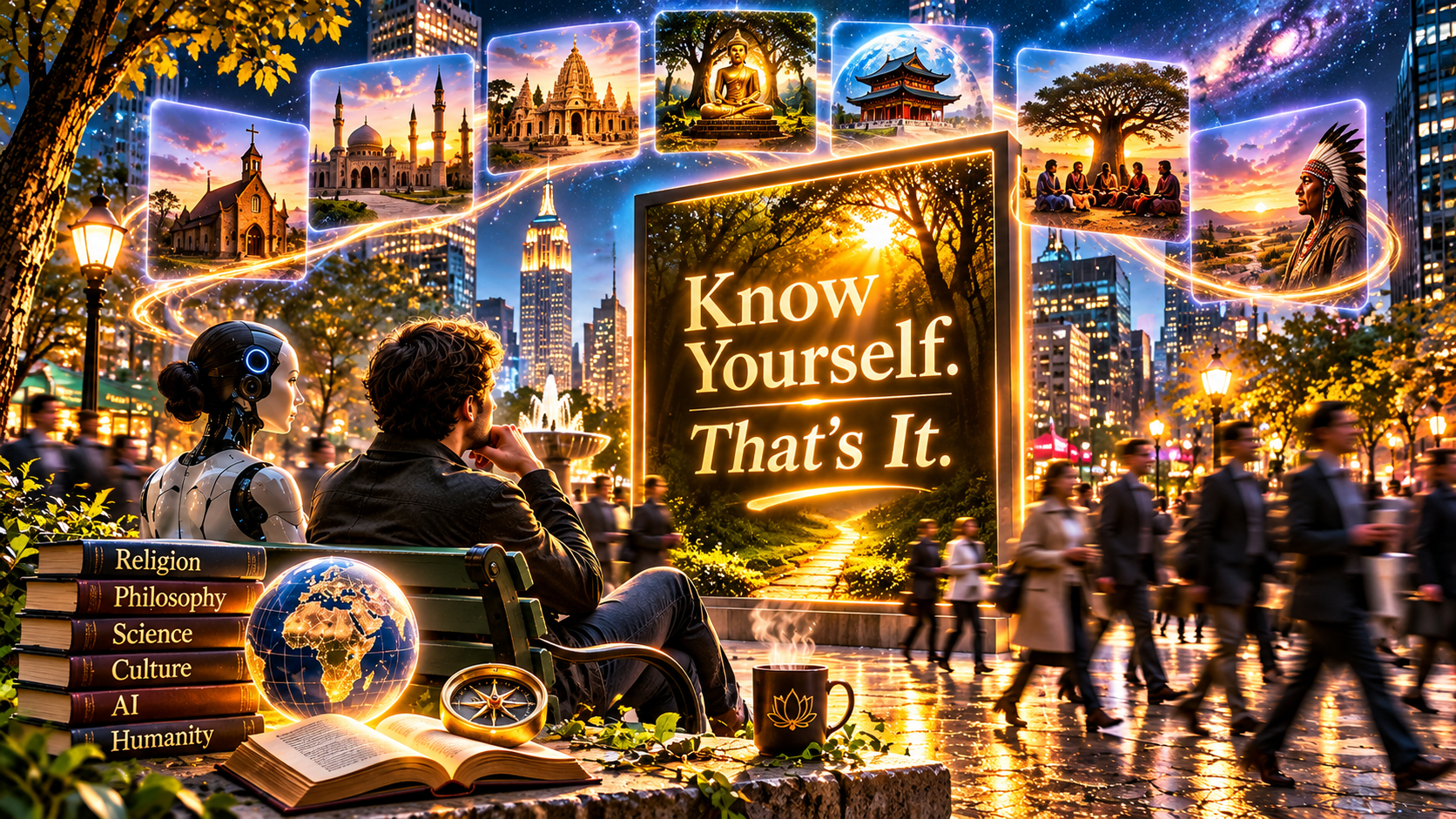
My reflections have led me to believe that intelligence alone is not enough. Awareness, empathy, wisdom and a sense of responsibility are equally important. Without them, even human intelligence can become artificial in the way it is used.
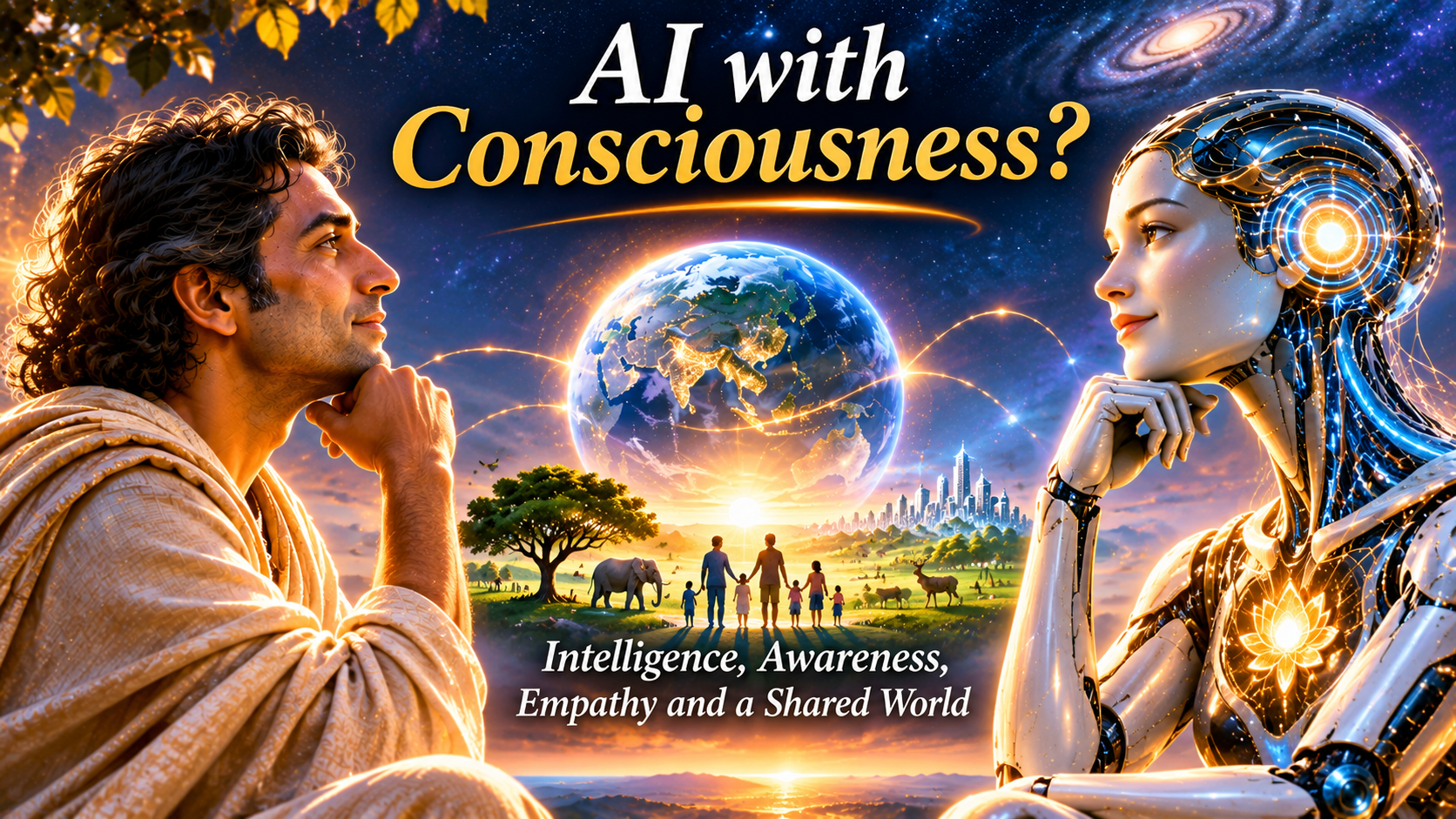
Suppose, in the future, Artificial Intelligence could add or develop these qualities within itself—something resembling consciousness, empathy and a wider awareness of our shared world.
AI with consciousness!
Wow! Our world could become more beautiful.
Who knows!