It can explain a complicated report, write a business plan and answer questions in seconds. But there is one problem we should never forget: an answer that sounds right is not always right.

I have been watching how quickly ChatGPT has become part of our everyday lives. People use it to write emails, understand difficult subjects, prepare business plans, create content and find answers to questions they might once have spent hours researching.
I use AI tools myself, and I find many of them fascinating. They can save time, open up new possibilities and help us do things we might otherwise struggle with.
But there is something about ChatGPT that deserves a little more attention.
It can be wrong and still sound completely convincing.

Think about that for a moment.
When someone tells us something we do not understand, we usually look for signs that the person knows what they are talking about. We listen to their explanation, consider their experience and sometimes ask somebody else.
ChatGPT can make this process confusing. It gives us a clear answer, explains it neatly and often sounds as if it has studied the subject for years. There may be no hesitation, no visible uncertainty and no obvious sign that something is wrong.
And that is where the trouble begins.
When a convincing answer goes wrong
Imagine that you receive a medical report containing words you cannot understand. You upload it to ChatGPT, and within seconds, you receive a simple explanation. Everything appears organised and easy to follow. You finally feel that you understand what the report means.
Naturally, you feel relieved.
But what if one important part of that explanation is incorrect?
You might make a decision based on it. You might delay speaking to your doctor because you believe there is nothing to worry about. The answer has not deliberately deceived you, but the result could still be serious.
The same problem can appear in business, education, finance and almost any other field.
A small business owner might ask ChatGPT whether a new idea is profitable. A student might use it to prepare an assignment. A writer might rely on it for facts and references. In each case, the answer may look perfectly reasonable.
The problem is that looking reasonable and being correct are two different things.
ChatGPT can sometimes produce information that is false, invent references that do not exist or misunderstand what a question requires. These errors are often called AI hallucinations. The technical name is less important than the simple fact behind it: AI can give us information that is not true.
And unless we check, we may never notice.
The danger is not always in the answer

Here is something I find particularly interesting.
The more useful a tool becomes, the easier it is to stop questioning it.
When we first try a new technology, we tend to be cautious. We test it, make comparisons and look for mistakes. But after it helps us several times, we begin to trust it. That trust grows naturally.
ChatGPT may help us write a good email today, explain a difficult subject tomorrow and suggest a useful idea the following week. Before long, we may start assuming that it is equally reliable when answering questions about our health, money or important decisions.
But success in one area does not guarantee accuracy in another.
A tool that writes beautifully is not necessarily a good source of medical advice. A tool that explains computer technology well may still make mistakes when discussing the law. Even an answer supported by several convincing details can contain an important error.
We should remember this whenever we use AI.
What happens when we stop thinking for ourselves?

There is another side to this story.
ChatGPT can help us think, but it can also make it tempting to avoid thinking altogether.
Suppose you are writing an article. You ask ChatGPT to develop an idea, improve the language and organise the story. That is useful. You bring the subject and your judgement; the tool helps you work through it.
Now imagine that you accept everything it produces without reading it carefully. You publish the article without checking its facts, questioning its arguments or deciding whether it truly says what you wanted to say.
The work may look polished. But how much of your own judgement went into it?
This does not mean that using AI makes us less intelligent. Used thoughtfully, it can help us learn and explore ideas. The concern is what happens when we allow convenience to replace our own effort.
We still need to question, compare, understand and decide. Those responsibilities do not disappear simply because a machine can produce an answer in seconds.
Let AI help you think. Do not let it do all your thinking for you.
What if ChatGPT agrees with you?

Let us look at another everyday situation.
You have an opinion about something. Perhaps you believe a business idea will succeed, or you are convinced that a particular explanation is correct. You ask ChatGPT about it, and the answer seems to support your view.
You feel reassured.
But have you learned anything new, or have you simply received a convincing explanation of what you already wanted to believe?
A useful answer should not merely tell us what we want to hear. Sometimes we need somebody — or something — to point out what we have missed.
That is why it can help to ask ChatGPT questions such as:
“What could be wrong with my idea?”
“What evidence might contradict this conclusion?”
“What are the strongest arguments on the other side?”
These questions can reveal weaknesses we had not considered. Of course, the answers themselves can also be mistaken, so they are starting points for further thought, not final proof.
The aim is not to make ChatGPT agree with us or disagree with us. It is to use it to examine an issue more carefully.
The stakes will only get higher
ChatGPT is no longer used only for answering simple questions or writing paragraphs. AI tools are increasingly being developed to work with documents, analyse information, use connected services and carry out sequences of tasks.
That creates exciting possibilities. It also means that mistakes may have consequences beyond a single incorrect sentence.
If an AI tool misunderstands a document, its analysis may be wrong. If it uses incorrect information to prepare a recommendation, that recommendation may also be flawed. If it can take actions on our behalf, careless use can create further problems.
The more responsibility we give these tools, the more carefully we need to supervise them.
This is not a reason to reject AI. It is a reason to understand what we are using and where its limits lie.
After all, we would not normally hand over an important responsibility to someone without checking whether they could handle it. We should not abandon that common sense simply because the technology is impressive.
So, can we trust ChatGPT?

I think the better question is: how much should we trust it, and for what purpose?
If you want help improving a paragraph, generating ideas or explaining an unfamiliar concept, ChatGPT can be an excellent assistant.
If you are making an important medical, legal or financial decision, the approach must be different. Check reliable sources, consult qualified professionals where necessary, and do not treat a confident AI response as a substitute for proper advice.
If the answer contains statistics, quotations, research findings or references, verify them before publishing or relying on them. If something seems surprising, check it independently. And if you cannot establish whether an important claim is true, do not present it as a confirmed fact.
These are simple habits, but they can make a real difference.
We do not need to distrust every answer ChatGPT gives us. We need to understand that trust should depend on the situation and the evidence.
The final thought
I believe AI is one of the most interesting developments of our time. It gives ordinary people access to capabilities that once seemed far beyond their reach. It can help us create, learn, solve problems and explore ideas in ways that were difficult to imagine only a few years ago.
I would not want people to miss those opportunities because they are afraid of the technology.
But I would not want them to accept everything it says simply because it sounds intelligent, either.

There is a difference between using a tool and surrendering your judgement to it. We must learn to recognise that difference.
ChatGPT may give you a brilliant answer. It may even explain that answer better than a human could. But when the information matters, the responsibility to question it remains with you.
And perhaps that is the point we should remember as AI becomes a bigger part of our lives.
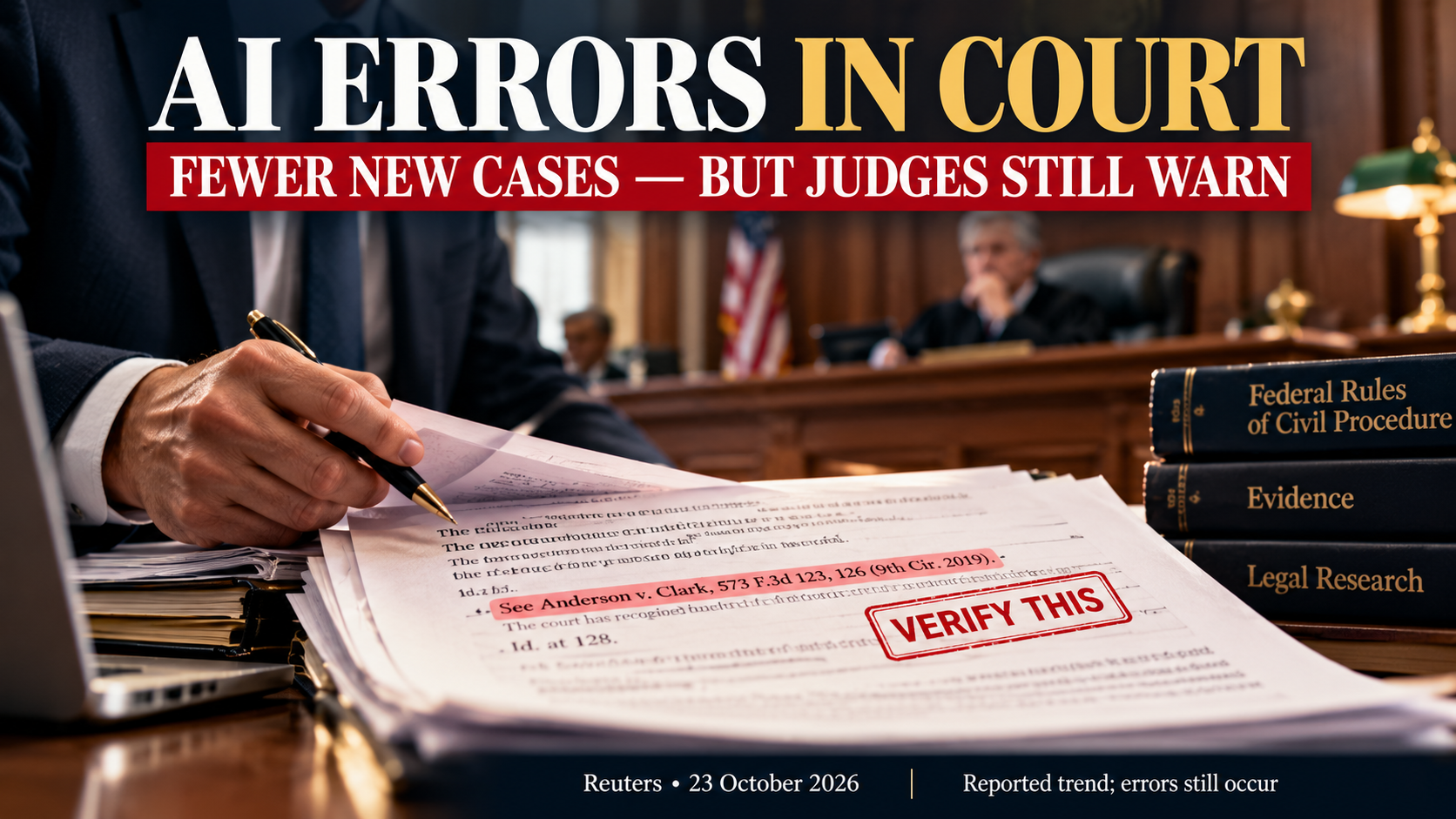
A new Reuters report published on 23 October 2026 highlights a worrying development: AI-related errors in US court filings appear to be declining, but judges continue to warn about fake legal references, inaccurate information and poorly prepared documents. Researchers tracking these cases suggest that improved AI tools and greater caution may be helping, although the decline in reported incidents does not necessarily mean the problem has disappeared. The danger remains that lawyers and ordinary people may trust AI-generated legal information without checking it carefully. In court, a convincing answer is not enough — every case citation, quotation and legal claim must be verified before it is submitted.
Source: Reuters — AI errors in court filings show signs of slowdown, but judges still sound alarms
The real danger is not simply that ChatGPT can get things wrong. It is that we may become so impressed by its answers that we forget to ask whether they are right.