• The World’s Most Famous Derrière!

    The World’s Most Famous Derrière!

    How do you define success in life?

    From Charcoal to Artificial intelligence

    Is it about money, fame, professional achievements, or the recognition we receive from others? Perhaps success is something much simpler and more meaningful. It is about discovering what fascinates us, following that curiosity, learning along the way, and finding the courage to embrace change.

    Sometimes, the seeds of a lifelong passion are planted in the most unexpected moments of childhood. A small incident, a curious question, or even a simple experiment can shape the direction of an entire life.

    My own journey began with four little pieces of lead type in a printing workshop when I was just eight years old. I had no idea that those four letters would leave such a lasting impression on me, eventually leading to a lifelong association with printing, publishing, creativity, and technology.

    Decades later, the printing world has travelled an extraordinary distance — from movable type and mechanical presses to offset, screen and digital printing, and now artificial intelligence.

    This is not just a story about the evolution of printing. It is also a story about curiosity, passion, adaptation, and the joy of never stopping learning.

    The World’s First Printing Machine: A Funny German Story and My Own Journey into Printing

    From a German washing-day accident to four little metal letters that changed my childhood — and eventually, from traditional printing to artificial intelligence.

    An unusual story from Germany

    Once upon a time in Germany, a mother and her little son went to a riverside washing place for their weekly laundry and bath.

    The mother found a comfortable place near the water. She seated her little boy on a smooth rock and stepped into the river. With the water reaching her waist, she began washing the clothes.

    The boy soon became bored. Looking around, he found a piece of charcoal lying nearby. He picked it up and started drawing on the smooth rocks.

    He drew pictures, scribbled letters, and made all sorts of marks. He was enjoying himself so much that he completely forgot about everything else.

    His mother continued washing for quite some time. Eventually, she became tired and decided to take a little rest.

    An unexpected discovery

    She came out of the water and sat down on a nearby smooth rock.

    Now, this mother was a rather well-built woman, with particularly large and heavy buttocks!

    She was still wearing her wet white garment. As she sat down, the wet cloth stuck firmly to her back and pressed against the charcoal drawings the little boy had made on the rock.

    She rested there for a while.

    After feeling refreshed, she got up and returned to her washing.

    But something unexpected had happened!

    All the little boy’s drawings and writings had been transferred onto the back of her white garment. The charcoal marks had left clear impressions across the cloth.

    It was quite an amazing sight!

    News spreads across Germany

    By this time, a few other people had arrived at the riverside.

    They noticed the pictures all over the woman’s back and were astonished. They looked closely, laughed, and started telling others about the strange incident.

    The news spread quickly.

    Before long, the woman and her unusually large backside had become famous throughout Germany!

    Eventually, the news reached the engineers of that time.

    They became interested in how the pictures had been transferred from the rock onto the wet cloth. They started thinking about whether this accidental process could be developed into a practical method of reproducing pictures and writing.

    Further experiments supposedly followed, and the idea eventually led to the development of the printing machine.

    And so, according to this wonderfully amusing German tale, the journey of printing began with a little boy’s charcoal drawings and his mother’s unfortunate washing-day experience!

    My own first encounter with printing

    This funny German story reminds me of something from my own childhood.

    My father was a university professor and also a writer who authored his own books. When I was just eight years old, he once sent me to a nearby printing press to collect the page proofs of one of his books.

    Those were the days of letterpress printing.

    The compositor had arranged the metal letters by hand and prepared page proofs for my father to read and correct.

    I would collect the proofs, take them home, and give them to my father. After he marked the necessary corrections, I would return them to the press the following day and collect the corrected pages.

    It became part of my little routine.

    But I was much more interested in what was happening inside the printing press!

    I was fascinated by the way the compositor applied ink to the arranged metal type and operated a small proofing machine to print each page separately. Watching those tiny metal letters turn into printed words on paper was like magic to me.

    I would stand there watching everything with great curiosity.

    Four little letters that made me a hero!

    One day, while looking at the compositor’s collection of individual metal letters, I had an idea.

    I picked out four letters from the composing rack:

    H – A – R – I

    I wanted to see my own name in print!

    The compositor uncle noticed what I was doing. Instead of stopping me, he smiled and decided to help.

    He carefully arranged the four metal letters in the correct order, joined them together with a rubber band, applied ink to their printing surfaces, and pressed them onto a clean white sheet of paper.

    And there it was!

    HARI

    My name appeared beautifully on the paper in blue ink.

    Oh, what a joy!

    I had never imagined that seeing my own name printed could give me so much happiness.

    The compositor uncle was kind enough to give me those four little lead letters along with some printing ink as a gift.

    I took them home, feeling as though I had received something very precious.

    I immediately found a new use for my little printing set. I started printing my name on the front covers of all my schoolbooks.

    The following day, when I brought those books to the classroom, my classmates were amazed. Everyone wanted to know how I had managed to print my name on the covers.

    For an eight-year-old boy, it was a wonderful moment.

    I felt like a hero in front of my schoolmates!

    Looking back today, I realise that my fascination with printing had started much earlier than my professional career.

    Perhaps those four little metal letters were the beginning of a lifelong relationship with the printing industry.

    From charcoal to artificial intelligence

    Jokes aside, there is an interesting connection between the German tale and the evolution of printing technology.

    The basic idea behind printing is to reproduce images and information from one medium onto another.

    Over the centuries, this simple principle developed into some remarkable technologies.

    1. Woodblock printing

    Images and letters were carved into wooden blocks and transferred onto paper. This method was used in Asia centuries ago.

    2. Movable type

    Johannes Gutenberg’s printing system in fifteenth-century Europe changed the world of book production. Individual metal letters could be arranged, inked, and used repeatedly to print pages.

    3. Offset printing

    Offset printing introduced another clever transfer process. The image moved from a printing plate to a rubber blanket and then onto paper. This became one of the most important technologies in commercial printing.

    4. Digital printing

    Computers brought another major revolution. Images and text could be sent directly from digital files to printing machines, without the traditional printing plates used in offset printing.

    5. Artificial intelligence

    And now we have entered another exciting chapter.

    With AI, we can create illustrations, photographs, artwork, designs, and even complete visual concepts simply by describing what we want.

    We no longer need charcoal, wooden blocks, metal type, or printing plates to create an original image.

    A few lines of text can be enough to turn an idea into a beautiful picture.

    A printing technologist’s perspective

    Having spent nearly three decades in the printing and publishing industry, I find this journey particularly fascinating.

    I have seen the industry move from letterpress and offset printing to screen printing, flexography, digital printing, and now AI-assisted creativity.

    Every new technology has changed the way we create, reproduce, and share information.

    The printing industry has never stopped evolving.

    Today, AI is opening another door. It is not just helping us reproduce existing images; it is helping us create things that previously existed only in our imagination.

    Think about it.

    A little boy once needed only a piece of charcoal, a smooth rock, and a little imagination to create his drawings.

    Another little boy, just eight years old, needed four metal letters, some ink, and the kindness of a compositor uncle to discover the magic of printing his own name.

    Today, we can give an AI tool a few sentences and ask it to create an entire illustrated world.

    The tools have changed beyond recognition, but the creative instinct remains the same.

    And if that little German boy were alive today, perhaps he would simply upload a photograph of his charcoal drawings and ask an AI assistant:

    “Can you invent a printing machine based on this?”

    AI might produce the design in seconds!

    But I wonder what his mother would have to say about it!

    Funny how a little story can bring back memories of our own beginnings.”

    The little boy who once printed HARI with four pieces of lead type is now creating stories with AI.


    Melody AI Hub — Dream, Learn & Create.

  • DRACULA: THE IMMORTAL COUNT – PART 3

    DRACULA: THE IMMORTAL COUNT – PART 3

    What’s a book or movie that genuinely scared you?

    THE FINAL BATTLE

    Bram Stoker’s legendary Gothic horror story

    Before the Journey to England

    Count Dracula had lived for centuries in the dark mountains of Transylvania, surrounded by ancient forests, ruined villages and fearful people. His castle stood isolated among the mountains, and the people of the surrounding countryside knew enough about him to avoid approaching it.

    But Dracula’s ambitions had grown beyond the boundaries of his homeland.

    He wanted a new world—one filled with people, movement and endless opportunities to feed. London, with its enormous population and crowded streets, offered exactly what he needed. Among millions of ordinary people, he believed he could hide his true nature and hunt without attracting too much attention.

    His decision was not a sudden one. He had studied the English language, learned about the country’s customs and carefully arranged to purchase an old estate called Carfax, near London. He also needed help with the legal arrangements, which brought the young solicitor Jonathan Harker to his castle.

    Jonathan had no idea that his visit was part of a much larger and darker plan.

    Dracula was preparing to leave Transylvania, carrying with him boxes filled with the sacred earth of his homeland—the earth he needed for his resting places. His journey would take him across the sea to England, where he intended to establish a new kingdom of darkness.

    But he had not considered one thing: his arrival would awaken forces that would eventually unite against him.


    Chapter 1: The Ghost Ship

    The Ghost Ship: The Demeter approaches the English coast, carrying a terrible secret.

    Count Dracula had escaped the mountains of Transylvania, but his journey was far from over. He had a new destination: England.

    Inside a large wooden sailing ship named Demeter, several heavy boxes filled with Transylvanian earth had been loaded. Hidden among them was the Count himself. He needed this native soil because it gave him the power to rest and regain his strength.

    The ship sailed from the Black Sea towards England. At first, the voyage appeared ordinary. But soon, strange things began to happen.

    One by one, members of the crew disappeared.

    The sailors searched the vessel, questioned one another and inspected the cargo. Nobody could explain what was happening. Some whispered about a mysterious presence moving through the ship at night. Others believed that something evil had joined them aboard.

    The captain became increasingly frightened. He knew that his men were vanishing, but he could find no explanation.

    As the ship approached England, the situation became terrifying. The remaining sailors were overcome by fear. Eventually, the captain was left alone.

    Determined to complete his duty, he tied himself to the ship’s wheel so that he would not abandon his post, whatever happened.

    When the Demeter finally reached the English coast, the captain was found dead, still tied to the wheel. A crucifix hung around his neck.

    The ship had arrived, but almost everyone aboard was dead or missing.

    Something terrible had travelled with it.

    Chapter 2 – The Arrival at Whitby

    Dracula Arrives at Whitby

    The Demeter reached Whitby during a violent storm.

    Dark clouds covered the sky. Powerful waves crashed against the harbour, and the wind howled through the streets. The people gathered along the coast to witness the strange arrival of the ship.

    As the vessel struck the shore, a huge black dog suddenly leapt from its deck and disappeared into the darkness.

    The people were astonished. Nobody knew where the animal had gone.

    But the black dog was no ordinary creature.

    It was Dracula.

    He had reached England.

    The heavy boxes of earth were unloaded and transported to Carfax, an old estate near London that the Count had purchased. Other boxes would eventually be sent to several properties across the country.

    Dracula had established his new hiding places. England, with its crowded streets and unsuspecting people, was now his hunting ground.

    Meanwhile, at Whitby, Mina Murray was spending time with her close friend Lucy Westenra.

    Neither woman knew that the arrival of the mysterious ship had brought a terrible danger into their lives.

    Chapter 3 – Lucy Westenra and the Strange Visitor

    Lucy was young, beautiful and loved by three men.

    Arthur Holmwood, a wealthy gentleman, was the man she truly loved. Dr John Seward, who managed a mental asylum, was another of her admirers. The third was Quincey Morris, a brave and generous American.

    Lucy eventually accepted Arthur’s proposal of marriage.

    Although Seward was disappointed, he remained her friend. Quincey also accepted her decision with remarkable kindness.

    Their lives continued, apparently untouched by the darkness spreading through England.

    But Lucy had begun to experience strange disturbances.

    She sometimes walked in her sleep. Mina noticed this behaviour and became increasingly concerned. One night, Lucy left her bed without waking properly and wandered outside.

    Mina searched for her and eventually found her in the churchyard, sitting near an old stone bench.

    A dark figure appeared close to Lucy.

    Mina could not clearly see its face, but something about it frightened her. When she approached, the figure disappeared into the darkness.

    Lucy seemed weak and confused. Mina took her home and noticed two tiny marks on her neck.

    At first, she assumed they were caused by an insect bite.

    She had no idea that Dracula had already begun feeding on her friend.

    Dracula was travelling towards the Black Sea aboard a ship carrying his final box of Transylvanian earth.

    Chapter 4 – The Mysterious Illness

    Lucy returned to her usual life, but her health gradually deteriorated.

    She became pale and weak. Her sleep was disturbed, and she often appeared exhausted even after resting.

    Mina eventually had to leave Whitby after receiving news about Jonathan. He had been found in a hospital in Budapest, seriously ill after his escape from Transylvania. Mina travelled to him, leaving Lucy behind.

    Jonathan and Mina were reunited. He was still suffering from the horrors he had experienced, but her presence brought him comfort. They were married in Budapest before returning to England.

    Meanwhile, Lucy’s condition continued to worsen.

    Dr Seward examined her but could not understand the cause of her strange weakness. He became worried enough to contact his former teacher, Professor Abraham Van Helsing, a distinguished doctor from Amsterdam.

    Van Helsing arrived and examined Lucy carefully.

    He immediately suspected that her illness was not ordinary.

    He arranged a blood transfusion, with Arthur providing the first donation. For a time, Lucy appeared stronger. But the improvement did not last.

    Van Helsing later brought garlic flowers and placed them around her room. He instructed Lucy and her mother not to remove them.

    He believed the flowers would protect her from the mysterious force attacking her.

    But Lucy’s mother did not understand the reason for this strange treatment. Thinking that the flowers and their strong smell were making her daughter uncomfortable, she removed them and opened the windows.

    That night, disaster struck again.

    A large wolf smashed through the bedroom window. The household was thrown into panic. Lucy’s mother, already suffering from a weak heart, was overwhelmed by the shock and died.

    The maids were also found helpless, having been drugged during the confusion.

    Lucy was left alone and unprotected.

    Dracula had returned.

    Chapter 5 – The Last Breath of Lucy

    Van Helsing and Dr Seward continued their efforts to save Lucy.

    Her condition became desperate. She needed more blood, and Arthur, Seward and Van Helsing each gave blood to keep her alive. Quincey Morris also joined the effort.

    Despite their sacrifices, Lucy grew weaker.

    Her appearance began to change. Her lips became unusually red, and her teeth seemed sharper. At moments, she displayed a strange expression that none of them had seen before.

    Van Helsing understood what was happening, but he could not yet explain everything to the others.

    Lucy was no longer simply suffering from an illness. Dracula was transforming her into one of his kind.

    Eventually, Lucy died.

    Arthur was devastated. Seward and Quincey were deeply affected, while Van Helsing remained unusually watchful.

    He knew that death would not necessarily end Lucy’s suffering.

    After her funeral, strange reports began to appear in the newspapers. Children in the neighbourhood were disappearing for short periods and returning frightened, with small wounds on their necks.

    They spoke of a beautiful woman who had approached them at night.

    The children called her the Bloofer Lady.

    Van Helsing feared the truth.

    Lucy had returned from the grave.

    Chapter 6 – The Bloofer Lady

    Van Helsing took Dr Seward and Arthur to Lucy’s tomb.

    When they opened the coffin, they discovered that it was empty.

    The men were horrified.

    Van Helsing insisted that Lucy was walking at night, searching for victims. Seward struggled to accept the explanation, but the evidence became impossible to ignore.

    They returned to the tomb again.

    This time, they saw Lucy.

    She was standing outside the cemetery, carrying a child in her arms. Her face was beautiful, but her expression was cold and unnatural.

    When she noticed the men, she called to Arthur in a voice that sounded almost like the Lucy he had loved.

    Arthur was shaken. For a moment, he wanted to believe that his beloved had returned.

    But Van Helsing stopped him.

    The woman before them was no longer the Lucy they remembered. She was a vampire, and the innocent children she had attacked were in danger.

    The men prepared to free her from the curse.

    Arthur was given the terrible responsibility of driving a wooden stake through her heart.

    With great pain, he did what was necessary.

    Van Helsing then completed the ritual by removing her head and placing garlic in her mouth.

    The transformation was over.

    Lucy’s face finally regained the peaceful expression of the woman they had loved.

    Arthur had lost Lucy, but he had saved her from an eternal existence as a creature of darkness.

    The men now understood that Dracula himself had to be destroyed.

    Chapter 7 – The Hunters Unite

    By this time, Jonathan and Mina had returned to England.

    Jonathan had never forgotten the horrors of Castle Dracula. When he learned about the mysterious events surrounding Lucy, he began to suspect that the Count had reached England.

    Van Helsing examined Jonathan’s account of his experiences and recognised the connection.

    The group gradually came together:

    • Jonathan Harker, who had survived Dracula’s castle.
    • Mina Harker, intelligent, organised and determined.
    • Professor Van Helsing, whose knowledge of vampires guided the investigation.
    • Dr Seward, who had witnessed Lucy’s illness and death.
    • Arthur Holmwood, who had lost the woman he loved.
    • Quincey Morris, whose courage and loyalty never failed.

    Another important figure was Renfield, a patient at Dr Seward’s asylum.

    Renfield had developed a strange obsession with consuming living creatures. He collected flies, spiders and birds, believing that by eating them he could absorb their life force.

    His behaviour seemed increasingly connected to Dracula.

    Sometimes he spoke with extraordinary clarity. At other times, he became violent and unpredictable.

    Van Helsing suspected that Renfield could sense the Count’s presence.

    The men began investigating Dracula’s movements and discovered that he had brought numerous boxes of Transylvanian earth into England.

    These boxes were essential to his survival. They allowed him to rest in places far from his homeland.

    The hunters located the boxes at Carfax and other properties in London.

    They entered the buildings and placed sacred objects inside the boxes, making them unsuitable for Dracula to use.

    One by one, his hiding places were destroyed.

    The Count was losing his protection.

    But he was not finished.

    Chapter 8 – Dracula’s Revenge

    Dracula soon discovered that someone was destroying his resting places.

    He realised that Jonathan, Van Helsing and their companions were working against him.

    His anger was terrible.

    One night, the hunters returned to their investigation and found Renfield gravely injured. Before he died, he revealed what had happened.

    Dracula had entered the asylum and attacked him.

    Renfield had attempted to resist the Count, but Dracula was too powerful.

    The men hurried towards the Harkers’ room.

    What they found there was far worse.

    Jonathan lay unconscious. Mina was trapped in Dracula’s power.

    The Count had forced her to drink blood from his own chest, creating a horrifying connection between them.

    Mina was terrified and deeply ashamed. She feared that she was becoming part of the very evil they were fighting.

    Dracula looked at the men with cold satisfaction.

    He knew that Mina’s connection to him would become a weapon against them.

    Van Helsing tried to protect her using a sacred object, but when it touched her forehead, it left a mark.

    The mark was evidence of the terrible bond between Mina and the vampire.

    The hunters were devastated.

    Jonathan’s hair had turned white from the shock. Mina feared that she might eventually become a vampire herself.

    But she refused to surrender.

    She made the men promise that if she ever became one of the undead, they would free her just as they had freed Lucy.

    The promise was painful, but they agreed.

    Their mission had become even more urgent.

    Chapter 9 – Mina’s Terrible Connection

    Although Mina was suffering, she had an important advantage.

    Because Dracula had forced her to drink his blood, she had developed a strange psychic connection with him.

    Van Helsing discovered that, under hypnosis, Mina could sometimes sense what Dracula was experiencing.

    When the Count was resting, she could sense darkness and silence. When he travelled by water, she could hear the movement of waves and the sounds of a ship.

    This connection became a valuable source of information.

    Mina also helped the group organise every piece of evidence they had collected. She studied the shipping records, letters, maps and other documents, searching for clues about Dracula’s movements.

    Her intelligence and careful reasoning proved essential.

    The hunters discovered that Dracula had escaped London and was returning to Transylvania by ship.

    He was heading home.

    Van Helsing understood that they had only one chance.

    They had to follow Dracula and destroy him before he reached the safety of his castle.

    The group began preparing for a dangerous journey across Europe.

    Chapter 10 – The Final Pursuit

    The hunters divided their efforts to intercept him.

    They travelled by different routes, using trains, boats and horses. Their journey took them through unfamiliar towns and across difficult countryside.

    Mina’s hypnotic connection helped them follow the Count’s movements.

    The closer they came to Transylvania, the more dangerous the journey became.

    The weather grew colder. Snow covered the mountains, and the roads became difficult to travel.

    The group knew that Dracula was approaching his castle.

    If he reached it before they caught him, he would once again become almost impossible to destroy.

    Van Helsing travelled with Mina towards the Borgo Pass, while the others pursued the ship and its cargo by separate routes.

    Jonathan and Quincey were determined to reach the Count before sunset.

    They knew that Dracula was most vulnerable during the hours when he was being transported in his box and had not yet returned to his resting place.

    Time was running out.

    Chapter 11 – The Three Women of the Castle

    As Van Helsing and Mina approached Castle Dracula, the professor knew that another danger awaited them.

    The three mysterious vampire women still lived there.

    They were the same creatures who had once approached Jonathan in the castle.

    Van Helsing entered the castle grounds and discovered them resting in their old hiding place.

    He understood that they could not be allowed to remain.

    Using the sacred objects he carried, he destroyed the three vampire women and ended their existence.

    Mina waited outside, protected from the castle’s evil influence.

    The professor then prepared to face the final stage of the battle.

    Far away, Jonathan and Quincey were racing towards the castle with the other men.

    Dracula’s carriage was approaching.

    The Count was almost home.

    Chapter 12 – The Last Battle

    The sun was beginning to sink behind the mountains.

    Dracula’s carriage was moving towards Castle Dracula, carrying the final box of earth.

    Jonathan and Quincey finally caught sight of it.

    They knew this was their last opportunity.

    A fierce struggle followed as the men attacked the carriage and tried to prevent Dracula from reaching the castle.

    The people guarding the Count fought desperately to protect him.

    Jonathan drew his kukri knife and struck at Dracula’s throat.

    At almost the same moment, Quincey Morris drove his Bowie knife into the Count’s heart.

    The attack was swift and decisive.

    Dracula’s body seemed to collapse and crumble into dust.

    The terrible expression disappeared from his face. For a brief moment, Jonathan thought he saw a look of peace where there had once been only cruelty.

    The Count was gone.

    But the victory came at a terrible price.

    Quincey Morris had been fatally wounded during the struggle. His friends gathered around him as he slowly died.

    He had given his life to destroy Dracula.

    Mina was finally free from the Count’s influence. The mysterious mark on her forehead disappeared, a sign that the curse had ended.

    The nightmare that had begun in Transylvania was over.


    Epilogue – Years Later

    Seven years passed.

    Jonathan and Mina had built a peaceful life together. They had a son, whom they named Quincey, in memory of the brave American who had sacrificed his life.

    The friends had survived an experience that few people would ever believe.

    They had confronted a creature who had lived for centuries, crossed oceans and continents, and brought terror into the modern world.

    Yet the final victory had come through courage, friendship, loyalty and the willingness to face an evil that seemed impossible to defeat.

    Castle Dracula remained a place of darkness and terrible memories.

    But the Count himself was gone.

    For Jonathan, the nightmare had begun with a journey to a distant castle.

    It ended with the destruction of the creature who had imprisoned him.

    And so the story of Dracula, the immortal Count, finally came to an end.

  • DRACULA: THE IMMORTAL COUNT – PART 2

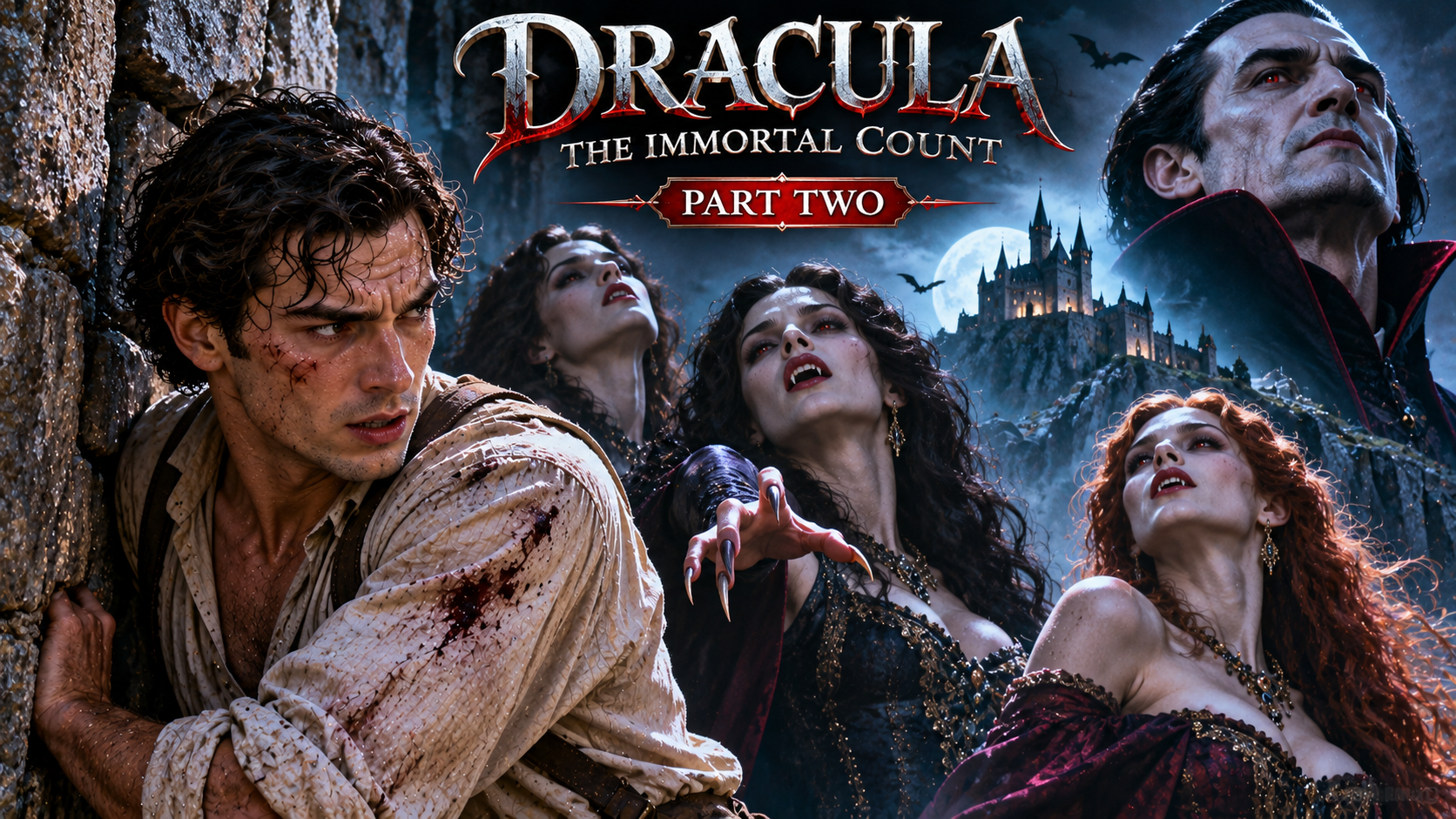
    DRACULA: THE IMMORTAL COUNT – PART 2

    What’s a book or movie that genuinely scared you?

    The Three Mysterious Women and the Escape | Chapter 3: The Forbidden Room

    After witnessing Count Dracula crawling down the castle wall like some enormous creature, Jonathan Harker could no longer pretend that everything was normal.

    His suspicions had become fears.

    The castle doors remained locked. There were no servants, no visitors and no apparent way to contact the outside world.

    Jonathan was a prisoner.

    One day, while Dracula was away, he decided to explore parts of the castle he had not previously visited.

    He walked through dark corridors and eventually discovered a pleasant room with comfortable furniture.

    Exhausted, he lay down and soon fell asleep.

    But he was about to experience something far more frightening than any nightmare.

    Chapter 4: The Three Mysterious Women

    Jonathan awoke with a strange feeling that someone was watching him.

    He opened his eyes.

    Three women were standing nearby.

    They were extraordinarily beautiful, but something about their appearance disturbed him. Their faces were pale, their eyes strangely bright, and their smiles carried an unsettling expression.

    One of them approached.

    She had long golden hair and red lips. She bent towards Jonathan, bringing her face close to his throat.

    Then he noticed her teeth.

    Two sharp points appeared between her lips.

    Jonathan was fascinated and terrified at the same time. He could neither move nor call for help.

    Suddenly, a powerful voice thundered through the room.

    “How dare you touch him!”

    The three women immediately stepped back.

    Count Dracula stood at the entrance.

    His expression was furious.

    The women looked at him with a mixture of fear and disappointment.

    One of them protested.

    “You never loved us!”

    Dracula’s face remained stern.

    “Have I not?”

    He moved towards them.

    “Yes, I can love. You know that well enough.”

    Then he pointed towards Jonathan.

    “This man belongs to me. Leave him alone!”

    Jonathan lay motionless, trying to understand what he had just witnessed.

    The three women slowly withdrew.

    But before leaving, one of them turned towards him and smiled.

    It was not a friendly smile.

    It was the smile of someone who knew that their next meeting might be very different.

    Dracula approached Jonathan.

    His expression had returned to its usual calmness.

    “Come,” he said. “You must return to your room.”

    Jonathan followed him, although his mind was filled with unanswered questions.

    Who were those women?

    Were they living in the castle?

    And why had Dracula stopped them?

    He wanted to ask, but something in the Count’s expression discouraged him.

    That night, Jonathan heard strange sounds from somewhere deep inside the castle.

    There were footsteps, whispers and occasional movements that seemed to come from the lower rooms.

    He now understood that the castle contained horrors far beyond his imagination.

    Chapter 5: The Child in the Bundle

    One night, Jonathan heard a woman crying outside the castle.

    “Give me back my child!”

    He moved towards the window and looked down into the darkness.

    Then he saw Dracula approaching, carrying a bundle.

    The Count threw it towards the three mysterious women.

    Jonathan realised with horror that the bundle contained a child.

    The mother’s cries continued.

    Dracula gave a signal, and a pack of wolves appeared.

    The woman screamed as they rushed towards her.

    Jonathan could hardly bear to watch.

    He had witnessed a terrible act of cruelty, and the man responsible was the same person who had welcomed him as a guest.

    Chapter 6: The Count’s Secret

    Jonathan continued observing Dracula whenever he could.

    One day, he noticed something deeply disturbing.

    The Count was wearing Jonathan’s clothes.

    A horrifying possibility entered his mind. Dracula might be using his appearance to deceive people outside the castle and make them believe that Jonathan was responsible for his actions.

    Jonathan was determined to discover more.

    He began searching the castle whenever Dracula was away.

    One day Jonathan discovered the Count’s secret resting place. He found a narrow staircase leading down towards the lower parts of the building.

    The air became colder as he descended.

    At the bottom, he discovered an old chapel.

    It appeared to have been abandoned for many years.

    The walls were damp, and the air carried the unpleasant smell of earth and decay.

    Rows of large wooden boxes stood inside.

    They looked like coffins.

    Jonathan approached one of them cautiously.

    Then he saw something that made him stop breathing.

    Inside lay Count Dracula.

    His eyes were closed.

    His face looked strangely different. The usual pale appearance had disappeared, and his cheeks seemed fuller and more youthful.

    His lips were red.

    His expression was peaceful, almost lifelike.

    But there was something even more disturbing.

    The Count appeared to be sleeping in a bed of earth.

    Jonathan stood staring at him.

    Could this really be the same man who had welcomed him at the castle entrance?

    He looked around.

    More boxes stood nearby, filled with the same dark earth.

    Jonathan suddenly understood that these were not ordinary storage containers.

    They were resting places.

    The Count was not sleeping like an ordinary human being.

    He seemed to belong to the earth itself.

    Fear slowly turned into anger.

    Jonathan realised that he might never escape if he did not act quickly.

    He noticed a heavy shovel nearby.

    Without thinking further, he picked it up and raised it above the sleeping Count.

    He brought it down with all his strength.

    But Dracula moved!

    The Count opened his eyes.

    Jonathan stumbled backwards in terror.

    The blow had failed to destroy him. It had only injured his forehead, from which a little blood appeared.

    The Count’s eyes were now open and filled with terrible anger.

    Jonathan dropped the shovel and fled from the chapel.

    He ran through the corridors, his heart pounding.

    He had tried to attack a creature that was not bound by the ordinary rules of life and death.

    He had discovered the Count’s secret, but he had failed to destroy him.

    Chapter 7: The Last Opportunity

    Jonathan knew that remaining in the castle meant certain danger.

    He had seen Dracula’s terrible powers. He had encountered the three women and witnessed the Count’s cruelty.

    He also knew that Dracula was wearing his clothes and might use his identity to commit further crimes.

    There was no longer any reason to wait.

    Jonathan decided to attempt an escape, even if it meant risking his life.

    He remembered how Dracula had climbed down the castle wall, moving headfirst like a lizard.

    It was an almost impossible route, but it offered a chance.

    He waited for an opportunity when the Count was away.

    For the first time since arriving in Transylvania, Jonathan Harker was no longer thinking about how to survive inside the castle.

    He was thinking about how to escape from it.

    He locked the door, although he knew that such a small barrier would offer little protection against Dracula.

    He sat beside the window and looked out towards the distant mountains.

    Somewhere beyond those mountains lay villages, roads and ordinary human life.

    He thought of England.

    He thought of his fiancée, Mina Murray, and wondered whether he would ever see her again.

    The thought of Mina filled him with sorrow.

    He had travelled to Transylvania expecting a few days of business discussions.

    Instead, he had discovered a nightmare.

    The Count was a creature of darkness.

    The three mysterious women were equally terrifying.

    The castle was a prison.

    And Jonathan was trapped among them.

    He began to understand that waiting would not save him.

    He had to escape.

    But how?

    The castle stood high above the surrounding landscape. The doors were locked, the windows were dangerous, and the Count seemed to know everything that happened within his walls.

    Jonathan looked once more towards the moonlit mountains.

    Then he made a decision.

    He would take whatever risk was necessary.

    He would rather face death outside the castle than remain a prisoner inside it.

    But he did not know that Count Dracula was already aware of his growing desperation.

    And the Count had no intention of allowing his guest to leave.

    Jonathan knew that he had to escape before it was too late.

    Jonathan returned to the window.

    He looked down at the enormous stone wall.

    The castle stood high above the surrounding landscape. The rocks below appeared distant and dangerous.

    But he remembered how Dracula had climbed down the wall.

    If the Count could do it, perhaps there was a way for Jonathan to follow.

    He carefully examined the stonework.

    There were small projections, narrow ledges and irregularities in the ancient masonry.

    It was a desperate plan.

    But he had no better choice.

    One evening, when the castle was unusually quiet, Jonathan prepared himself.

    He looked once more at his room.

    The comfortable bed, the furniture and the fireplace had once seemed welcoming.

    Now everything reminded him of his captivity.

    He approached the window.

    A cold wind entered the room.

    Far below, the darkness covered the mountains.

    Jonathan climbed onto the window ledge and began his dangerous descent.

    His hands searched for every small opening in the stonework.

    His feet struggled to find secure positions.

    He dared not look down.

    A single mistake could end his life.

    The height was terrifying.

    But he continued. The night seemed endless.

    Chapter 8: Beyond Castle Dracula

    Jonathan eventually reached the lower ground and made his way away from the castle.

    He was exhausted, frightened and uncertain of the route ahead.

    The mountains stretched before him, and the wilderness offered little protection.

    He carried the small crucifix given to him by the elderly woman before his journey.

    He thought of Mina and wondered whether he would ever see her again.

    He had escaped the castle, but he was not yet safe.

    The journey through the mountains became increasingly difficult. His strength failed, and his mind was troubled by fever and exhaustion.

    As Jonathan travelled away from the castle, the landscape gradually changed.

    The isolated mountain paths gave way to routes used by travellers and local villagers.

    He was no longer surrounded entirely by the silence of the wilderness.

    But his condition was becoming worse.

    His body was weak, and his mind was exhausted.

    At times, he could hardly distinguish between what was happening around him and what remained in his memory.

    The terrible experiences inside the castle had left him deeply disturbed.

    He thought he saw Dracula’s face in the darkness.

    He heard familiar voices.

    He remembered the mysterious women approaching him.

    And sometimes he felt that the Count was still watching him.

    He struggled onward until he could no longer continue.

    Chapter 9: A Place of Safety

    Jonathan’s escape did not end with his arrival in a nearby village.

    He eventually became seriously ill and was taken to a hospital in Budapest.

    There, he remained weak and confused, haunted by memories of the castle.

    News of his condition reached Mina Murray.

    Without hesitation, she travelled to Budapest to find him.

    When they finally met, Jonathan was overwhelmed with emotion.

    Jonathan looked weak and exhausted.

    His face had lost its usual colour, and his eyes carried the memories of something terrible.

    Mina approached him gently.

    “Jonathan!”

    He slowly turned towards her.

    For a moment, he seemed unable to recognise her.

    Then his expression changed.

    “Mina…”

    She held his hand.

    He had survived.

    After everything he had experienced, he was finally with someone he loved and trusted.

    Mina stayed beside him and helped him recover.

    She did not demand explanations or force him to speak about his terrible experiences.

    She understood that he needed time.

    The mysterious castle, the strange Count and the horrors of Transylvania remained locked inside Jonathan’s memory.

    But Mina was determined to help him return to normal life.

    Mina cared for him as he recovered, and the two were eventually married.

    During Jonathan’s recovery, Mina discovered his journal and read his detailed account of the terrifying journey through Transylvania—from the mysterious coachman and wolves to Dracula’s castle, the three strange women and his desperate escape. Although the events seemed almost unbelievable, Jonathan’s detailed descriptions and genuine fear convinced her that his experiences might be real. She carefully preserved the journal, sensing that it could prove important in the future.

    Jonathan’s experiences had left a deep mark on him.

    He had escaped from Count Dracula, but the nightmare was not over.

    Far away, the Count was preparing for a new journey.

    His destination was England.

    Jonathan Harker had escaped Castle Dracula. But Count Dracula was coming to his world.

    To be continued in Part Three: Dracula Comes to England.

  • Bram Stoker’s Dracula – The Immortal Count | Part One

    Bram Stoker’s Dracula – The Immortal Count | Part One

    What’s a book or movie that genuinely scared you?

    DRACULA

    The Book That Frightened Me

    Based on Bram Stoker’s legendary Gothic horror novel, first published in 1897.

    Before the Story: My First Encounter with Dracula

    If my memory serves me right, I was around eleven or twelve years old when I was first introduced to Bram Stoker’s Dracula.

    I borrowed the thick novel from a local library. But there was something about this particular book that made me hesitate to show it to my parents or sisters.

    My father was a bit orthodox-minded, and I suspected he wouldn’t be particularly happy to see me reading a frightening horror novel at such a young age. I wasn’t sure how he would react if he discovered it.

    So I decided to keep my new literary adventure entirely to myself.

    I secretly tucked the book inside my trousers, holding it against my stomach, and somehow managed to smuggle it upstairs into my little private room on the first floor of our house.

    I had a plan. I would wait until night.

    Those were different days. There was no television to keep us awake, no mobile phones to steal our attention. People went to bed early, unlike today. Reading books and working on little DIY projects were my favourite pastimes. I could spend hours exploring books or making something with my own hands.

    That night, I waited patiently.

    By around 9.30 or 10 o’clock, my parents and sisters had retired to their rooms. The house gradually became silent. One by one, the lights in the neighbouring houses went out. Outside, darkness had taken over.

    A gentle breeze drifted through my open bedroom window. The branches and leaves of the guava trees occasionally brushed against the window glass, making soft, unexpected sounds.

    It was the perfect atmosphere for reading a ghost story.

    I quietly entered my room, switched off the light and slipped into bed near the window. I didn’t dare keep the room light on. My father might suddenly come upstairs and catch me reading that book.

    I reached underneath my bed and pulled out my secret treasure.

    For a few seconds, I simply stared at its cover.

    There he was!

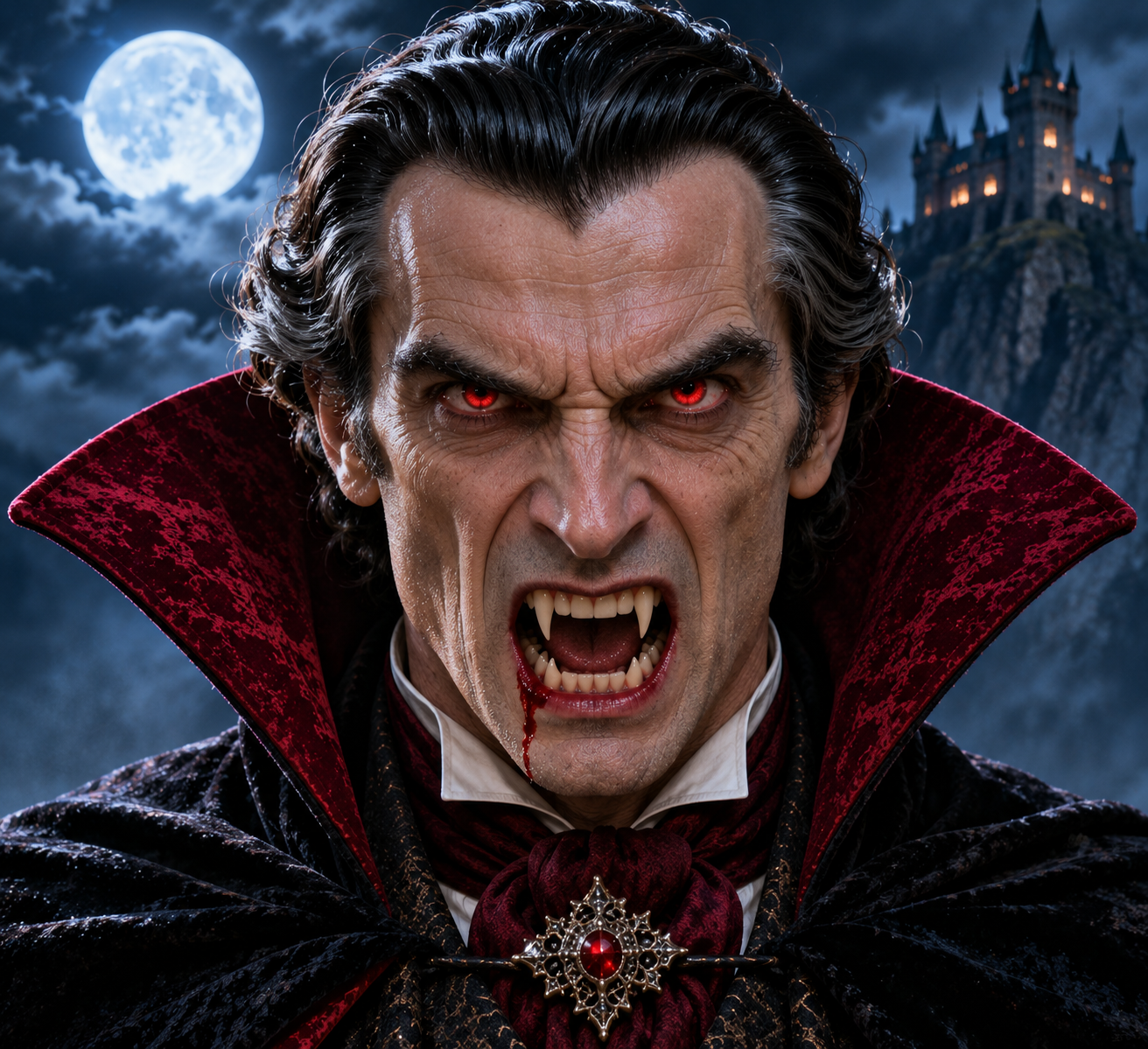
    A frightening face with a long, pale appearance, piercing red eyes, a sharp nose and an open mouth revealing two long, blood-stained fangs. Even the cover seemed to be warning me about the horrors waiting inside.

    I felt a little nervous.

    Then I switched on my tiny torch, holding it in one hand, and carefully opened the book.

    The first few pages drew me into another world. Slowly, the words began to paint pictures in my imagination. I could almost see the mysterious Count, his terrifying castle and the strange events surrounding him.

    But the real world around me was beginning to feel different, too.

    Every little movement outside caught my attention. Whenever the breeze stirred the guava tree branches or the leaves brushed against the window, I became frightened. Sometimes I would stop reading for a moment and listen.

    Was it just the wind?

    Or was something moving outside?

    I knew it was only my imagination, but that didn’t make the feeling any less frightening.

    Still, I couldn’t put the book down.

    Fear and curiosity were fighting inside me. The more frightened I became, the more eager I was to discover what happened next.

    With only the tiny torch illuminating the pages, I continued reading, completely absorbed in the mysterious world of Count Dracula.

    I had no idea that a book borrowed from an ordinary local library would leave such a lasting impression on my childhood memories.

    And now, after all these years, I want to take you back to that mysterious world.

    Let us turn the pages together.

    (Count Dracula – A nobleman of Transylvania)


    THE STORY BEGINS

    Chapter 1: A Journey into Darkness

    Imagine travelling through a remote mountain region where the roads are narrow, the forests are thick, and darkness arrives long before you expect it.

    This was Transylvania, a mysterious region of Eastern Europe, where ancient castles stood among the mountains and local legends spoke of things that ordinary people feared even to mention.

    A young English solicitor named Jonathan Harker was travelling there on business.

    His assignment was simple enough. He had been sent to meet a wealthy nobleman named Count Dracula, who wanted to purchase an estate in England. Jonathan was expected to complete the necessary legal arrangements.

    He had no reason to suspect that this ordinary business journey would become the most terrifying experience of his life.

    Before reaching the Count’s castle, Jonathan stopped at an inn in the town of Bistritz. The people there seemed unusually curious about his destination.

    When he mentioned the name Dracula, their expressions changed.

    Some looked frightened. Others whispered among themselves.

    Jonathan could not understand why.

    An elderly woman approached him. Her face carried an expression of genuine concern.

    “Are you really going to Castle Dracula?” she asked.

    “Yes,” Jonathan replied. “I have an appointment with the Count.”

    The woman looked at him as though he had announced his own death.

    She held out a small crucifix.

    “For your protection,” she whispered. “Please, take it.”

    Jonathan was surprised by her behaviour, but accepted the little cross to avoid offending her.

    Soon, other villagers gathered around him. Some made the sign of the cross. Others whispered prayers.

    He wondered whether these people were simply superstitious.

    After all, he was an educated Englishman, travelling on a perfectly legitimate business assignment. He had little reason to believe in local ghost stories.

    But something about their fear stayed in his mind.

    The following day, Jonathan continued his journey towards the Borgo Pass, the mountain passage leading to the Count’s castle.

    The landscape became increasingly wild.

    Forests covered the mountain slopes. Dark clouds gathered overhead. The road twisted through valleys and climbed towards distant peaks.

    As evening approached, Jonathan’s coach reached the appointed meeting place.

    A strange black carriage was waiting.

    Its driver was a tall man dressed in black. His face was difficult to see beneath his hat.

    “Mr Jonathan Harker?” he asked.

    “Yes.”

    “I have come to take you to the castle.”

    Jonathan climbed aboard.

    The carriage began moving through the mountain darkness.

    At first, everything seemed normal. But as they travelled deeper into the mountains, Jonathan noticed something unusual.

    The driver appeared to know every turn of the road, even though the darkness was almost complete.

    Occasionally, strange blue flames appeared near the roadside.

    Jonathan later learned that these were associated with old local legends about hidden treasures.

    But the strangest thing was yet to come.

    Wolves began howling in the distance.

    Soon the sounds grew louder. Jonathan could hear them moving through the forest, sometimes approaching so close that he could imagine their eyes watching the carriage.

    He became increasingly uncomfortable.

    At one point, the wolves surrounded the carriage.

    Jonathan was terrified.

    Yet the mysterious driver seemed completely untroubled. He raised his arms and shouted something into the darkness.

    To Jonathan’s astonishment, the wolves fell silent and moved away.

    Who was this man?

    How could he control wild animals so easily?

    Jonathan had no answer.

    The journey continued.

    At last, after what seemed like an endless ride through the mountains, the carriage stopped before an enormous castle.

    Its dark towers rose against the night sky. The building looked ancient, isolated and almost lifeless.

    There were no welcoming lights in its windows.

    No signs of ordinary human activity.

    Only darkness.

    The driver climbed down and opened the carriage door.

    Jonathan stepped out.

    He looked up at the enormous wooden entrance.

    The driver approached the door and knocked.

    For a moment, nothing happened.

    Then, slowly, the heavy doors began to open.

    A tall, elderly man stood inside.

    He had a pale face, a prominent nose, thin lips and unusually sharp features. His eyes were bright and strangely intense.

    He wore black from head to foot.

    “Welcome to my house,” he said.

    His voice was polite, almost gentle.

    “Come freely. Go safely, and leave something of the happiness you bring.”

    The man extended his hand.

    “I am Dracula.”

    Jonathan accepted the greeting.

    But the moment their hands touched, he felt an extraordinary chill. The Count’s grip was unusually strong, almost painfully so.

    Jonathan looked into the old man’s eyes.

    Something about them made him uncomfortable.

    Yet the Count smiled pleasantly.

    “Come in, Mr Harker. You must be tired after your long journey.”

    Jonathan stepped across the threshold.

    Behind him, the enormous castle doors slowly closed.

    He had arrived at his destination.

    He believed he was a guest in the home of a wealthy nobleman.

    He had no idea that the man welcoming him was hiding a terrible secret.

    And he had no idea how difficult it would be to leave.

    The night had only just begun.

    Chapter 2: The Secrets Behind the Castle Doors

    Jonathan Harker was exhausted after his long journey. The Count led him through several rooms and corridors before showing him to his bedroom.

    The castle was enormous, but something about it felt strangely empty.

    There were no servants walking through the corridors. No cooks, maids or other members of a household. Yet everything seemed to be prepared for his arrival.

    His bedroom was comfortable, and a fire was burning. A meal had been arranged, and the Count himself appeared to attend to his guest.

    Jonathan found this unusual.

    A wealthy nobleman living in such a magnificent castle would normally have an entire household of servants.

    But perhaps, he thought, the Count preferred privacy.

    That night, Jonathan sat with Dracula and discussed the business that had brought him to Transylvania.

    The Count was intelligent, well-spoken and remarkably interested in England.

    He asked Jonathan about English customs, London streets, houses, business and the people who lived there.

    He seemed particularly eager to learn everything about his future home.

    Jonathan was impressed by his host’s knowledge.

    But there was something unusual about the old gentleman.

    His face was pale, his fingers were strangely long, and his teeth appeared unusually sharp. When he smiled, Jonathan could see the points of his canine teeth.

    Still, he tried to dismiss his uneasiness.

    After all, he was in a foreign country, staying in an ancient castle with a man whose habits and appearance were unfamiliar to him.

    Perhaps that explained everything.

    Or so he wanted to believe.

    The Strange Discovery in the Mirror

    The following morning, Jonathan woke up and prepared to shave.

    He noticed a small shaving mirror among his belongings and placed it carefully against the window.

    As he began shaving, the Count suddenly entered the room.

    Jonathan was startled and accidentally cut himself.

    A small drop of blood appeared on his chin.

    The Count’s expression changed immediately.

    His eyes seemed to flash with an unnatural intensity. He seized Jonathan by the throat.

    For a moment, the young Englishman was terrified.

    Then Dracula noticed the little crucifix Jonathan was wearing.

    He released him.

    His expression changed again, and he quietly stepped back.

    Jonathan could not understand what had just happened.

    But something even stranger caught his attention.

    Looking at the mirror, he realised that he could see himself clearly.

    The Count, however, was nowhere to be seen in its reflection.

    Jonathan turned towards Dracula.

    The old man was standing directly behind him.

    Yet the mirror showed no image of him.

    Before Jonathan could properly understand what he had witnessed, Dracula seized the mirror and threw it out of the window.

    It crashed somewhere below.

    “You should keep your mirrors out of the way,” the Count said coldly.

    Then he left the room.

    Jonathan stood motionless.

    He tried to convince himself that there must be some explanation.

    But what explanation could there be for a man who cast no reflection?

    For the first time, the strange warnings of the villagers began to make sense.

    The Castle Has No Escape

    As the days passed, Jonathan noticed more disturbing things.

    The Count never appeared during daylight in the ordinary way people did. He seemed most comfortable during the night.

    He also discovered that the castle doors were locked.

    The entrance was inaccessible, and the windows were either too high above the ground or opened over terrifying drops.

    Jonathan began to realise that he was not free to come and go as he pleased.

    One evening, he tried to explore another part of the castle.

    He found rooms that appeared to have been abandoned for years. Dust covered the furniture, and silence filled the corridors.

    The place was full of strange shadows.

    He returned to his room with an uncomfortable feeling that he was being watched.

    But his greatest shock was still waiting for him.

    The Count on the Castle Wall

    One night, unable to sleep, Jonathan approached his bedroom window.

    The moonlight illuminated the enormous stone walls of the castle.

    He looked down into the darkness.

    Suddenly, he noticed something moving.

    At first, he thought it might be an animal.

    Then he recognised the familiar black clothing.

    It was Count Dracula.

    But the Count was not walking along a staircase or using any path.

    He was climbing down the outside wall of the castle!

    Jonathan watched in disbelief.

    The old man moved with extraordinary ease, using the stonework as though it were a staircase.

    Then Jonathan saw something that made his blood run cold.

    The Count was moving headfirst, with his body turned towards the ground.

    His hands and feet seemed to grip the stone like those of an enormous creature.

    He descended further and further until the darkness swallowed him.

    Jonathan stepped back from the window.

    His mind was racing.

    Who was this man?

    How could a human being move like that?

    Why did he have no reflection?

    And why was Jonathan being kept inside this enormous castle?

    The warnings of the villagers returned to his thoughts.

    He remembered the frightened faces at the inn, the mysterious crucifix and the strange journey through the mountains.

    Perhaps those people knew something he had been too confident to believe.

    Perhaps the stories were not merely superstitions.

    Jonathan Harker was beginning to understand the terrible truth.

    He had travelled thousands of miles to meet a wealthy nobleman and complete a business transaction.

    But now, inside these ancient walls, he was beginning to wonder whether he had entered the home of a man…

    Or the lair of something that had no place among the living.

    And somewhere in the darkness of that castle, Count Dracula was waiting.

    To be continued in Part Two: The Three Mysterious Women.

  • Ethiopia: The Journey That Changed My Life

    Ethiopia: The Journey That Changed My Life

    What’s the worst travel experience you’ve ever had?

    From Ethnic Unrest & the COVID Lockdown to a Road Accident in Addis Ababa: An Experience I Will Never Forget

    Some years remain etched in our memories. For me, 2019 and 2020 were unforgettable—not only because the world was gripped by COVID-19, but also because of the ethnic unrest in Ethiopia, the isolation of lockdown, and a road accident that turned an ordinary morning into a frightening ordeal.

    This is the story of those years, and of an accident that happened when I was simply looking for a cup of coffee.

    Life in Hawassa, Ethiopia

    During 2018–2020, I worked in Hawassa, a beautiful city in southern Ethiopia. The weather was generally pleasant, with cool mornings and frequent rain. I stayed at Hotel Rori, a hotel owned by the company I worked for.

    It was a large establishment with more than 100 guest rooms, five restaurants, pubs and bars, a gym, a spa, and a swimming pool. The company employed more than 500 people, and the hotel was an important part of its operations.

    My main responsibility was helping establish a new factory. I selected and purchased approximately 35 machines from countries including India, China, Germany, and the United Arab Emirates. I also coordinated the procurement of around 120 containers of raw materials, worked on the factory floor plan and machinery installation, and helped train local young people.

    It was demanding work, but I enjoyed the challenge.

    Living far from Kerala meant adjusting to unfamiliar food and customs. I often missed dosa, idli, sambar, tapioca, and fish curry. Fortunately, a Sri Lankan cook named Silva helped bring some familiar flavours into my life abroad.

    The local staple was injera, a large, soft, spongy flatbread with a slightly sour taste, usually served with a variety of stews and sauces. Gradually, I became accustomed to the food, the people, and the rhythm of life in Hawassa.

    I had no idea how dramatically that routine would change.

    When Ethnic Unrest Changed Everything

    Ethnic tensions escalated in the region, bringing reports of violence, destruction, and unrest. The atmosphere became increasingly uncertain, and everyday life was affected.

    Soldiers from the Ethiopian National Defence Force came to stay at Hotel Rori. A place that had once been busy with guests and staff now carried a different atmosphere.

    Communication became another serious problem. Telephone services and internet access were disrupted for nearly six weeks, making it extremely difficult to contact people outside the area. A state of emergency was declared, public transportation came to a halt, and movement became restricted.

    Being so far from home made the situation harder. Even a brief message from family would have been reassuring, but staying in touch was not always possible.

    Whenever circumstances permitted, I continued with my work. The factory project still required attention, despite the uncertainty surrounding us.

    Then the COVID-19 pandemic added another layer of difficulty.

    COVID-19 and a Journey to Addis Ababa

    As COVID-19 spread across the world, Ethiopia was also affected. Travel restrictions, fears of infection, and lockdown measures changed daily life. The unrest had eased in some places, but uncertainty remained.

    One of my work assignments required me to travel approximately 275 kilometres from Hawassa to Addis Ababa, Ethiopia’s capital, to oversee machinery installation.

    My boss owned a resort called Wohema, where I stayed during this period. Under the pandemic restrictions, the resort was largely closed. Only a few people remained to manage it: a manager, a cook, and three women staff members.

    With very few guests, the place was unusually quiet. One small inconvenience became part of my daily routine: breakfast and coffee were not always available early in the morning.

    I was accustomed to beginning the day with coffee, so I started looking for alternatives.

    Coffee, known locally as buna, is an important part of Ethiopian culture. Traditional coffee is often brewed in a rounded, black clay pot called a jebena, heated over charcoal and served in small cups. The preparation is a valued social custom in its own right.

    What began as a simple search for my morning coffee gradually became an appreciation of Ethiopian coffee culture.

    My local assistant eventually found a coffee shop across the road, near a bend. We could get our coffee there if we crossed the road safely.

    It seemed like an easy solution.

    The Morning of the Accident

    One morning, I was preparing to travel back from Addis Ababa to Hawassa. We were waiting for the driver, an uncle of my boss’s wife, who was expected to arrive around 6:30 a.m.

    There was no electricity at the resort that morning. I got up, had a bath, and got ready for the day. My assistant questioned why I needed to bathe so early, and we had a brief discussion about our different habits.

    The driver had still not arrived.

    By around seven o’clock, we decided to cross the road for coffee and return before he came. The shop was nearby, just across the road.

    I looked to my left and right before stepping onto the road. At first, it appeared safe.

    Suddenly, I heard my assistant shout, “Boss!”

    I turned towards him and saw two Bajaj three-wheeled vehicles approaching at high speed, side by side, around the bend.

    There was hardly any time to react.

    One of the vehicles struck me, and I lost consciousness.

    When I regained awareness, I was lying on the road. My face was covered in blood, my head had struck the ground, and my left hand was injured. The Bajaj that hit me had overturned and ended up in the bushes.

    My assistant stood nearby, shocked by what he had witnessed. People began gathering around us, and he came forward to help me.

    I had gone out for a cup of coffee while waiting for my journey back to Hawassa. Within moments, I was seriously injured and had no idea how badly I had been hurt.

    From a Local Clinic to a Major Hospital

    My assistant later told me that I was taken to a local primary health centre for initial treatment. I had multiple injuries and needed numerous stitches. According to him, around 30 to 40 stitches were put in during this first treatment.

    The care available there was not sufficient, so I needed to be taken to a larger hospital.

    My boss’s uncle helped arrange the journey to a major hospital in Addis Ababa. I was grateful that he was there to assist me.

    My upper lip had been split, and a piece of stone had become embedded in my forehead. I also had cuts, bruises, and injuries elsewhere on my body.

    At the hospital, the doctor concentrated on the wound in my forehead and my damaged upper lip. The procedure took approximately three hours, during which the doctor removed the embedded material and repaired my injuries.

    At one point, the doctor used a mirror to show me the situation and reassure me. I remember that small gesture because it helped me understand what was happening while I was receiving treatment.

    A scan was also carried out. Thankfully, it showed no serious internal injuries.

    As I remember it, I had around 45 injuries of different kinds. The exact number is difficult to establish, but the extent of the injuries made the experience particularly frightening. The reassuring scan result was a great relief.

    Four or Five Months at Hotel Rori

    Despite the accident and the hospital treatment, I returned to Hawassa the same day.

    I was physically injured and shaken by what had happened. My wounds needed time to heal, and I had to manage my recovery while living away from my family.

    For the next four or five months, during the lockdown, I spent much of my time at Hotel Rori. Restrictions limited movement and social activities, and the hotel was far quieter than it had been before.

    Much of the time, I was alone. With fewer opportunities to go out or meet people, the days could feel long.

    I gradually recovered from my injuries while continuing to deal with the uncertainty of life in Ethiopia. COVID-19 was a major concern, but ethnic tensions had not disappeared entirely, and unrest sometimes returned.

    Those months were a test of patience. I had to adjust to the circumstances, take care of myself, and wait for life to become more predictable.

    A Road Known for Accidents

    Some time later, I spoke with the manager at Wohema resort about the accident. He told me that the stretch of road near the bend had a reputation for frequent collisions.

    According to him, accidents occurred there regularly, sometimes once or twice a week, and fatalities were reported every month. I had no independent way of verifying those figures, but hearing his account made me wonder why we had not been warned about the danger.

    The coffee shop was close enough to reach on foot. Crossing the road had seemed like an ordinary, harmless decision.

    Had we known about the bend’s reputation, we might have reconsidered crossing there.

    That conversation stayed with me because it highlighted how easily we can overlook risks in familiar-looking surroundings.

    A Journey I Will Never Forget

    Years later, while writing this story, I came across the news of the December 2021 helicopter crash near Coonoor in Tamil Nadu, which claimed the lives of General Bipin Rawat and 12 others. It brought back memories of my own accident in Ethiopia.

    Looking back at those years, I remember the challenges of setting up the factory, the people I worked with, the ethnic unrest, the COVID-19 lockdown, and the months I spent recovering at Hotel Rori.

    Yet the morning in Addis Ababa remains unforgettable. I was preparing to travel back to Hawassa, waiting for a driver, and had stepped out for a cup of coffee. That simple decision changed the course of my day.

    I survived, received the treatment I needed, and eventually recovered. What remains with me is the memory of that unexpected ordeal and the help I received when I needed it most.

    I went out for a cup of coffee. I never imagined that it would become the most unforgettable journey of my life.

  • Know Yourself…That’s It!

    Know Yourself…That’s It!

    If you had to sum up your life philosophy in one sentence, what would it be?

    God, Me and the Search for Truth

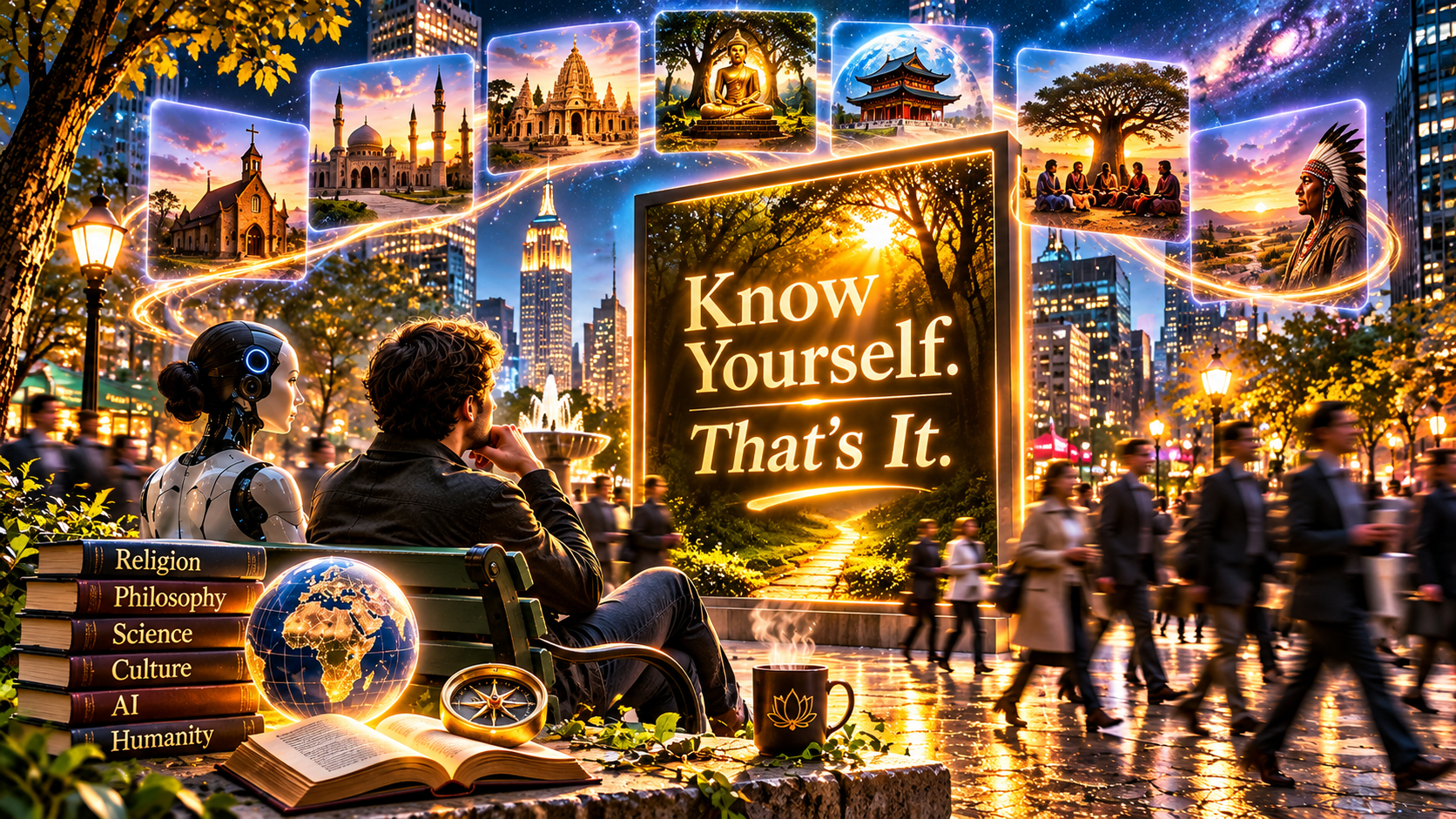
    Know Yourself… That’s It!

    Before asking someone to explain the ultimate nature of reality, we should also ask how we know what we claim to know—and what we may still be unable to know.

    Know Yourself. That’s It.

    Different people have found different answers to life’s biggest questions. Some believe in a personal God. Others understand ultimate reality as something beyond human description. Some spiritual traditions question the very idea of a permanent self. Others believe that nature and the laws of the universe may be sufficient to explain our existence. Many people are still searching.

    Despite centuries of debate, these questions have not disappeared. They remain part of human life, culture, science and philosophy.

    Now, another development has entered this long conversation: artificial intelligence.

    AI can explain religious teachings, compare philosophical ideas and summarise scientific discoveries in seconds. It can bring together information that might otherwise take months to collect. This makes exploring different answers to humanity’s oldest questions easier than ever before.

    But the arrival of AI does not change the basic challenge.

    Information is not the same as truth, and a convincing explanation is not necessarily a correct one.

    Can AI help us understand the ultimate questions? To explore that possibility, we must first understand what we are asking.

    What Do We Mean by God?

    Before discussing whether God exists, we need to recognise that people do not always mean the same thing when they use the word God.

    For many believers, God is a personal creator who knows, guides and sustains the universe. In some philosophical traditions, ultimate reality is understood as something that goes beyond the image of a personal creator. Other traditions question whether the universe requires a creator at all !

    These are genuine differences, not merely different words for the same idea.

    Consider a simple example. When someone asks who built a house, we can usually identify the builders and explain how it was constructed. When we ask how the universe began—or why anything exists at all—we encounter a much more difficult question.

    Science investigates the universe’s early development, its physical laws and the processes through which stars, planets and galaxies formed. But explaining how the universe developed is not necessarily the same as answering why there is something rather than nothing.

    Some people see the existence of the universe as a reason to believe in God. Others argue that we should not assume a divine explanation simply because certain questions remain unanswered.

    Both positions deserve careful examination. Neither should be accepted or rejected without considering the reasoning behind it.

    Has Humanity Found Any Answers?

    Yes, in many areas. In others, important questions remain open.

    Science has explained many things that were once mysterious. We understand far more about the formation of stars, the development of life and the workings of the human brain than people did centuries ago. These discoveries have transformed our understanding of the natural world and humanity’s place within it.

    Yet scientific progress has not produced universal agreement about God’s existence.

    A scientific account of how the universe developed does not, by itself, establish whether God exists. Equally, the limits of present scientific knowledge do not establish that a supernatural explanation must be correct.

    Religion and philosophy have also developed substantial bodies of thought. They offer arguments about existence, morality, consciousness and the nature of reality. Their conclusions differ, and some claims conflict with one another.

    Examining these perspectives fairly means looking at their original teachings, the reasoning behind their claims, their historical contexts and the objections they have faced.

    We do not need to pretend that every question has an answer. But neither should we overlook the knowledge and insights humanity has already developed.

    Can Intelligence Explain Everything?

    Our ability to think has helped us understand the world, yet human knowledge has limits. We can study distant galaxies without travelling to them. We can investigate the brain while still debating how conscious experience arises. We can explain many natural processes without agreeing on the ultimate meaning of existence.

    Artificial intelligence introduces a powerful new intellectual tool. It can organise information, identify connections between ideas and help people examine arguments from different viewpoints.

    But there is an important distinction between explaining an idea and establishing its truth.

    AI can describe a religious experience without demonstrating that it has experienced anything itself. It can present arguments for and against God, but the strength of those arguments depends on their evidence, logic and assumptions—not on how confidently an AI system presents them.

    AI is therefore neither proof of God nor disproof of God. Its value lies in helping us investigate what people believe, why they believe it and how their claims stand up to careful scrutiny.

    There is also a wider question. If an artificial system can perform tasks that once seemed to require human intelligence, what does this tell us about intelligence itself? Does intelligent behaviour necessarily involve consciousness, or can some forms of intelligence exist without it?

    These questions matter in their own right, whether or not they lead us to conclusions about God.

    One World, Many Ways of Thinking

    No single culture has had a monopoly on questions about existence.

    Indian philosophical traditions, Chinese thought, Islamic theology and philosophy, Jewish and Christian traditions, African philosophies, Indigenous worldviews, Western philosophy and non-religious approaches have all developed distinct ways of understanding reality and human life.

    They should not be treated as interchangeable. A philosophical teaching within a religion may differ considerably from the everyday beliefs and practices of its followers. Traditions also contain disagreements, reinterpretations and debates within themselves.

    The fairest approach is to understand each perspective on its own terms before comparing it with another.

    We should neither dismiss an idea because it comes from an unfamiliar tradition nor accept it simply because it is ancient or widely followed. The same standard applies to scientific and philosophical claims: examine the evidence, question the assumptions and recognise uncertainty where it exists.

    The purpose is not to make every belief agree with every other belief. It is to understand each perspective fairly and identify what remains unresolved.

    The Search Continues

    Perhaps the most useful starting point is to acknowledge two things: humanity has learned a great deal, and some fundamental questions remain unresolved.

    We do not have to choose between unquestioning belief and automatic disbelief. We can examine evidence, consider reasoned arguments, learn from different traditions and admit uncertainty when the evidence does not justify a firm conclusion.

    Artificial intelligence may make this process faster and more accessible. It can help us discover overlooked arguments and understand viewpoints outside our own experience. But it can also repeat errors, misrepresent traditions and sound certain when the evidence is incomplete. Human judgement and independent verification remain essential.

    The goal is not to make AI deliver a final verdict on God. It is to use our growing knowledge and new intellectual tools responsibly, without deciding the conclusion in advance.

    The question of God is much older than artificial intelligence. What is new is our ability to gather, compare and examine information on an unprecedented scale.

    Whether that opportunity brings us closer to understanding will depend not simply on how much information we possess, but on how carefully we learn to think.

    And perhaps the search should begin closer to home.

    Before trying to explain the universe, we can examine our own assumptions, our fears, our beliefs and the limits of our understanding. Knowing ourselves will not automatically answer every question about God or reality. But it may help us ask those questions more honestly.

    Know Yourself. That’s It.

    Explore more in the continuing series, “God, AI and the Search for Truth.”

    Read the full series at: https://melodyaihub.com/2026/10/30/god-ai-search-for-truth/

  • God and Artificial Intelligence: An Old Question in a New Age.

    God and Artificial Intelligence: An Old Question in a New Age.

    By Melody AI Hub

    Human beings have wondered about God for thousands of years. Who created the universe? Why does life exist? What happens after death? Is there a purpose behind our existence, or are we simply part of a vast natural process?

    Different people have found different answers. Some believe in a personal God. Others understand God as an ultimate reality beyond human description. Some follow spiritual traditions that question the very idea of a permanent self. Others believe that nature and the laws of the universe are enough to explain our existence. Many people are still searching.

    Despite centuries of discussion, these questions have not disappeared. They remain part of human life, culture, science and philosophy.

    Now, another development has entered this long conversation: artificial intelligence.

    AI can explain religious teachings, compare philosophical ideas and summarise scientific discoveries in seconds. It can bring together information that might otherwise take a person months to collect. This makes it easier than ever to explore different answers to the oldest questions.

    But the arrival of AI does not change the basic challenge. Information is not the same as truth, and a convincing explanation is not necessarily a correct one. Can AI Help Us Understand the Ultimate Questions?

    What Do We Mean by God?

    Before discussing whether God exists, we need to recognise that people do not always mean the same thing when they use the word God.

    For many believers, God is a personal creator who knows, guides and sustains the universe. In some philosophical traditions, the ultimate reality is understood in a way that goes beyond the image of a person who creates the world. Other traditions question whether the universe needs a creator at all.

    These are genuine differences, not merely different words for the same idea.

    Consider a simple example. When someone asks who built a house, we can usually identify the builders and explain how it was constructed. When we ask how the universe began, however, we are dealing with a much larger problem. Science can investigate the universe’s early development, but the question of why there is something rather than nothing reaches beyond a simple account of construction.

    Some people see the existence of the universe as a reason to believe in God. Others argue that we should not assume a divine explanation simply because some questions remain unanswered.

    Neither position should be accepted without examining its reasoning.

    Has Humanity Found Any Answers?

    Yes, in some areas. In others, important questions remain open.

    Science has explained many things that were once mysterious. We understand far more about the formation of stars, the development of life and the workings of the human brain than people did centuries ago. These discoveries have changed how we understand our place in the universe.

    Yet scientific progress has not produced universal agreement about God’s existence. A scientific account of how the universe developed does not, by itself, establish whether God exists. Equally, the limits of present scientific knowledge do not establish that a supernatural explanation must be correct.

    Religion and philosophy have also developed substantial bodies of thought. They offer arguments about existence, morality, consciousness and the nature of reality. Their claims differ, and some conflict with one another. Examining them carefully means looking at their original ideas, the reasoning behind them and the objections they have faced.

    We do not need to pretend that every question has an answer. But neither should we overlook the answers and insights humanity has already developed.

    Can Intelligence Explain Everything?

    Our ability to think has helped us understand the world, yet human intelligence has limits. We can study distant galaxies without travelling to them. We can describe the brain while still debating how conscious experience arises. We can understand many natural processes without agreeing on the ultimate meaning of existence.

    Artificial intelligence introduces a new kind of intellectual tool. It can organise information, find connections between ideas and help people examine arguments from different viewpoints.

    But there is an important distinction between explaining an idea and establishing its truth. An AI system can describe a religious experience without demonstrating that it has experienced anything itself. It can present arguments for and against God, but the quality of those arguments depends on the evidence, logic and sources involved.

    AI is therefore neither a proof of God nor a disproof of God. Its real value lies in helping us examine what people believe, why they believe it, and how their claims stand up to careful scrutiny.

    There is also a wider question here. If an artificial system can perform tasks that once seemed to require human intelligence, what does that tell us about intelligence itself? Does intelligent behaviour necessarily involve consciousness, or can some forms of intelligence exist without it? These questions matter in their own right, whether or not they lead us to conclusions about God.

    One World, Many Ways of Thinking

    No single culture has had a monopoly on questions about existence.

    Indian philosophical traditions, Chinese thought, Islamic theology and philosophy, Jewish and Christian traditions, African philosophies, Indigenous worldviews, Western philosophy, and non-religious approaches have all developed distinct ways of thinking about reality and human life.

    They should not be treated as interchangeable. A philosophical teaching within a religion may differ considerably from the customs and everyday beliefs of its followers. A tradition may also contain disagreements within itself.

    The fairest approach is to understand each view on its own terms before comparing it with another. We should neither dismiss an idea because it comes from an unfamiliar tradition nor accept it simply because it is ancient or widely followed.

    The same standard applies to modern scientific and philosophical claims.

    The Search Continues

    Perhaps the most useful starting point is to admit two things: humanity has learned a great deal, and some fundamental questions remain unresolved.

    We do not have to choose between blind belief and automatic disbelief. We can examine evidence, consider reasoned arguments, learn from different traditions and acknowledge uncertainty where it genuinely exists.

    Artificial intelligence may make this process faster and more accessible. It may help us discover overlooked arguments or understand viewpoints outside our own experience. But it can also repeat errors, misrepresent traditions and sound certain when the available evidence is not conclusive. Human judgement and independent verification remain essential.

    The goal is not to make AI deliver a final verdict on God. It is to use our growing knowledge and new intellectual tools responsibly, without deciding the conclusion in advance.

    The question of God is much older than artificial intelligence. What is new is the opportunity to examine the question with an unprecedented ability to gather and compare information.

    Whether that opportunity brings us closer to an answer will depend not on how confidently a machine speaks, but on how carefully we learn to think.

    At Melody AI Hub, the search begins with curiosity, continues through evidence and reasoning, and remains open to conclusions that the facts genuinely support.


    GOD, AI AND THE SEARCH FOR TRUTH

    PART TWO: Nine Perspectives on God and Reality

    Part One ends by asking:

    “Are we discovering the nature of reality, or are we still trying to understand the limits of the minds with which we investigate it?”

    To explore that question, we must examine how different traditions have approached God, reality, and the self. Their answers differ profoundly. Some begin with a Creator, others with ultimate reality or the nature of consciousness, while some question whether a divine explanation is necessary at all.

    The purpose is not to make every belief agree with every other belief. It is to understand each perspective on its own terms, examine its reasoning fairly, and identify what remains unresolved.

    The sections below follow a consistent approach: each presents a tradition’s central ideas, its contribution to the search for truth, a critical question, and the role AI might play in examining it.

    1. Christianity — God, Creation and Love

    Christianity is the world’s largest religious affiliation. According to Pew Research Center’s estimates for 2020, Christians represented approximately 28.8% of humanity.

    Christianity teaches belief in one God. Mainstream Trinitarian Christianity understands God as Father, Son, and Holy Spirit, while some Christian groups interpret God’s nature differently. Jesus Christ stands at the centre of Christian faith, particularly through his teachings, crucifixion, and resurrection. The Bible provides its central scriptural foundation.

    Christian thought addresses creation, moral responsibility, free will, redemption, and the relationship between humanity and God. The idea that humans are made in God’s image has also influenced discussions of dignity and human worth.

    The critical question: If God is loving and all-powerful, why do innocent people suffer, and why does profound injustice persist?

    Christian thinkers offer different responses, including human freedom, the consequences of evil, and the possibility that human understanding is limited. These answers are debated rather than universally accepted.

    AI can compare biblical interpretations and philosophical arguments, but textual analysis alone cannot prove God’s existence or establish a divine event as certain.

    2. Islam — The Oneness of God

    Islam is the world’s second-largest religious affiliation, representing approximately 25.6% of the global population in 2020.

    Its central principle is Tawhid: the absolute oneness and uniqueness of God, Allah. Muslims regard the Qur’an as divine revelation received by the Prophet Muhammad. Islamic teachings emphasise worship, compassion, justice, accountability, and responsible conduct.

    Allah is not simply a name introduced with Islam. The name was known in pre-Islamic Arabia, although religious understandings and practices varied across time and communities. Islam established a distinct and uncompromising emphasis on worship of the one God.

    Islamic intellectual traditions have explored the relationship between revelation and reason, divine knowledge and human freedom, and the existence of suffering in a world created by God.

    The critical question: How can divine justice be reconciled with human freedom, unequal circumstances, and apparently undeserved suffering?

    AI can compare Qur’anic interpretations and historical evidence. It must distinguish the history of religious beliefs from claims accepted through faith, and it must not confuse a generated explanation with proof of revelation.

    3. Non-Religious Perspectives — Does Reality Require God?

    Non-religious worldviews include atheism, agnosticism, and secular humanism. These positions are not identical: atheism concerns belief in God or gods, agnosticism concerns knowledge or uncertainty, and secular humanism emphasises human welfare and ethical responsibility without requiring religious belief.

    This category deserves careful demographic context. Pew estimated that religiously unaffiliated people represented 24.2% of the world’s population in 2020, making them the third-largest category in its global classification. They are not a religion, and not every unaffiliated person is an atheist.

    Some non-religious thinkers argue that natural explanations are sufficient to investigate the universe. Others suspend judgment, maintaining that neither God’s existence nor non-existence has been conclusively established.

    The critical question: Does the existence of the universe require a divine explanation, or could reality exist without a Creator?

    AI can evaluate logical arguments, examine scientific evidence, and expose unsupported assumptions. However, science’s success in explaining natural processes does not by itself settle every metaphysical question. Equally, the limits of scientific knowledge do not automatically prove a supernatural explanation.

    The honest approach is to distinguish what is known, what is inferred, and what remains uncertain.

    4. Hindu Traditions — Tat Tvam Asi

    Hinduism encompasses diverse religious and philosophical traditions rather than one uniform doctrine. Some emphasise devotion to a personal God; others investigate the nature of consciousness, the self, and ultimate reality. The Upanishads and Bhagavad Gita are important sources for these inquiries.

    The Sanskrit expression Tat Tvam Asi—“That Thou Art”—appears in the Chandogya Upanishad. In Advaita Vedanta, associated with the philosopher Shankara, it expresses the essential identity of Atman, the deepest self, and Brahman, ultimate reality. Other schools, including Vishishtadvaita and Dvaita, understand the relationship between the self and ultimate reality differently.

    These differences matter. It would be inaccurate to claim that all Hindus accept the Advaita interpretation.

    The critical question: Is the deepest self identical with ultimate reality, related to it, or fundamentally distinct from it?

    Self-inquiry invites people to examine whether identity is merely the body, thoughts, memories, and personality—or whether these point towards something deeper. Yet a philosophical claim about the self is not automatically established by the experience of introspection.

    AI can explain the schools, compare translations, and examine arguments. It cannot claim spiritual realisation simply because it can describe it.

    5. Buddhism — The Nature of Self and Suffering

    Buddhism begins not primarily with a creator God, but with the problem of suffering and the possibility of liberation. The Four Noble Truths describe suffering, its causes, its cessation, and the path towards that cessation. The Eightfold Path sets out principles for ethical conduct, mental discipline, and wisdom.

    Many Buddhist traditions teach Anatta, or non-self: the view that no permanent, independent self can be found within the changing processes of body and mind. This is not simply the assertion that people do not exist. It challenges the idea of an unchanging, independent essence behind experience.

    Buddhist traditions differ in their philosophies, cosmologies, devotional practices, and understandings of spiritual beings. Although Buddhism generally does not require belief in a creator God, it cannot be reduced to a single secular philosophy.

    The critical question: If there is no permanent, independent self, how should we understand personal identity, moral responsibility, and continuity through time?

    AI can compare Buddhist philosophy with neuroscience and cognitive science, but correlations between brain activity and experience do not answer every question about consciousness. Nor does explaining meditation amount to practising it.

    6. Chinese Traditions — The Dao and the Way of Living

    Chinese religious and philosophical traditions include Daoism, Confucianism, and diverse forms of popular religion. These traditions overlap historically in some contexts, but they are not interchangeable.

    Daoism explores the Dao, often translated as “the Way”: the course or underlying order of reality that cannot be fully captured by ordinary language. The Dao De Jing explores simplicity, spontaneity, and action that does not rely on excessive force.

    Confucianism places greater emphasis on ethical relationships, social responsibility, ritual, education, and the cultivation of character. Its questions often concern how human beings can live well together rather than how to prove a single account of creation.

    The critical question: Must truth be expressed as a doctrine about a Creator, or can it also be approached through experience, harmony, and the cultivation of wisdom?

    These traditions challenge the assumption that every inquiry into ultimate reality must begin with the same question. They also raise questions about whether a life of wisdom depends more on abstract knowledge or on the way knowledge shapes conduct.

    AI can explain classical texts and compare interpretations. But it should not force distinct Chinese traditions into categories developed for other religions, nor mistake a fluent summary for lived wisdom.

    7. African Philosophies and Religious Traditions — Relationship and Community

    Africa contains a vast diversity of philosophical, religious, and cultural traditions. Some understand existence through relationships among human beings, ancestors, the natural world, and spiritual powers. Others are shaped by Christianity, Islam, secular philosophy, and contemporary intellectual movements.

    The concept of Ubuntu, associated with several southern African traditions, highlights the significance of human interdependence and community in the formation of personhood. It is influential, but it is not a universal summary of all African philosophies.

    Many African intellectual traditions also preserve knowledge through oral history, storytelling, communal practice, and ethical teaching. These forms of knowledge deserve serious examination rather than being dismissed simply because they are not always recorded in written philosophical systems.

    The critical question: Can truth and human identity be understood through individual reasoning alone, or are relationships and responsibilities essential to both?

    AI can assist with language preservation, the study of oral histories, and comparison of philosophical ideas. Yet its sources may be incomplete, and digital access does not confer ownership of cultural knowledge. Communities must retain authority over what they choose to share.

    8. Indigenous Worldviews — Humanity Within the Living World

    Indigenous peoples across the world hold distinct traditions shaped by their histories, languages, lands, and relationships. Some understand humans, animals, ancestors, places, and spiritual beings as participants in an interconnected world. Knowledge may be transmitted through stories, ceremonies, observation, and responsibilities passed between generations.

    There is no single Indigenous worldview. Different peoples have different accounts of creation, the sacred, moral responsibility, and the relationship between humans and nature. These traditions should not be reduced to one romantic idea of universal harmony.

    They nevertheless invite an important examination of modern assumptions: whether the natural world should be understood mainly as a resource for human use, or also through relationships, obligations, and forms of value that cannot be measured in money.

    The critical question: What dimensions of reality and responsibility might be overlooked when nature is treated only as an object to control?

    AI may help document endangered languages and preserve cultural material when communities consent. But it must respect restricted knowledge, cultural rights, and the authority of Indigenous peoples. Information gathered by technology is not automatically knowledge that technology is entitled to interpret or distribute.

    9. Judaism — One God, Justice and Responsibility

    Judaism teaches belief in one God and places importance on the relationship between God, humanity, and the Jewish people. The Torah stands at the heart of Jewish scripture, while centuries of interpretation, debate, law, and philosophical inquiry have shaped Jewish religious life.

    Jewish thought explores creation, morality, suffering, justice, and human responsibility. Its interpretive traditions show how difficult questions can remain open to sustained debate. Jewish thinkers have offered different accounts of divine providence, the problem of evil, and the limits of human understanding.

    Judaism is also a living tradition with diverse communities and interpretations; no single philosophical explanation represents every Jewish person.

    The critical question: How can belief in a just and compassionate God be reconciled with suffering, injustice, and the apparent silence of God?

    AI can compare biblical passages, examine historical contexts, and explain competing interpretations. It must distinguish the text itself from later commentary and avoid presenting one interpretation as the only Jewish answer.

    Judaism reminds us that the search for truth may involve not only discovering what is believed, but also examining how beliefs shape conduct, responsibility, and the pursuit of justice.

    What Have We Learned From These Nine Perspectives?

    These nine perspectives do not offer nine versions of one identical answer. They differ in their starting points, methods, and conclusions.

    Some affirm a personal Creator. Some investigate ultimate reality through the relationship between self and cosmos. Some concentrate on suffering and liberation; others emphasise ethical relationships, community, or humanity’s responsibilities towards the natural world. Non-religious thinkers question whether a divine explanation is necessary or sufficiently supported.

    Fairness does not require pretending these positions agree. Nor does it require treating every claim as equally well supported. It requires examining each claim in context, using consistent standards, and acknowledging where evidence is incomplete.

    Where Does AI Stand in This Search?

    AI can make this investigation more informed. It can compare scriptures, explain philosophical arguments, identify historical developments, and help readers distinguish a primary source from a later interpretation. It can also reveal how the same question receives different answers across traditions.

    But AI has limitations. It can produce factual errors, overlook context, reproduce biases, and sound certain when the evidence is uncertain. It can explain an experience without having that experience, and describe a spiritual practice without possessing the human life in which that practice takes place.

    Most importantly, AI cannot settle a metaphysical question merely by producing a persuasive answer. The ability to describe an argument is not proof of its conclusion. The ability to analyse religious texts does not establish or disprove God.

    The same discipline must apply in every direction. An unanswered scientific question does not automatically prove God, and a successful scientific explanation does not automatically disprove God.

    The Search Turns Inward

    We began with the limits of the minds through which we investigate reality. After examining different traditions, we return to the question of the investigator.

    The Upanishadic tradition invites self-inquiry through Tat Tvam Asi. Buddhism asks us to investigate the changing processes we identify as the self. Religious traditions invite reflection on God, revelation, devotion, and responsibility. Secular philosophies challenge us to examine whether our conclusions require supernatural assumptions.

    These approaches cannot simply be merged into one doctrine. Their differences are real, and honest inquiry must preserve them.

    Yet each perspective can encourage us to question our assumptions rather than accept them uncritically.

    Perhaps the most useful role of AI is not to choose our beliefs, but to help us investigate what we believe, why we believe it, and what might cause us to reconsider. The responsibility for judgment remains human.

    Before asking AI to explain the ultimate nature of reality, we should also ask how we know what we claim to know—and what we may still be unable to know.

    Know Yourself. That’s It.

    Not as a final answer imposed on every religion or worldview, but as an invitation to begin the search with honesty, humility, and an open mind.


    References and Further Reading

    1. Pew Research Center — How the Global Religious Landscape Changed From 2010 to 2020: https://www.pewresearch.org/religion/2025/06/09/how-the-global-religious-landscape-changed-from-2010-to-2020/
    2. Bible Gateway — Christian scripture: https://www.biblegateway.com/
    3. The Qur’an — Islamic scripture: https://quran.com/
    4. Upanishadic texts: https://www.upasanayoga.org/EngU.htm
    5. Stanford Encyclopedia of Philosophy — Śaṅkara: https://plato.stanford.edu/entries/shankara/
    6. Stanford Encyclopedia of Philosophy — Buddhism: https://plato.stanford.edu/entries/buddhism/
    7. Sefaria — Genesis and Jewish commentary: https://www.sefaria.org/Genesis.1?with=Rashi
    8. Dao De Jing: https://ctext.org/dao-de-jing
    9. Analects: https://ctext.org/analects
    10. Stanford Encyclopedia of Philosophy — Africana Philosophy: https://plato.stanford.edu/entries/africana/
    11. United Nations Declaration on the Rights of Indigenous Peoples: https://www.un.org/development/desa/indigenouspeoples/declaration-on-the-rights-of-indigenous-peoples.html
    12. Stanford Encyclopedia of Philosophy — Cosmological Argument: https://plato.stanford.edu/entries/cosmological-argument/
    13. Stanford Encyclopedia of Philosophy — The Problem of Evil: https://plato.stanford.edu/entries/evil/

    Editorial note:

    These nine perspectives differ in scope: some are religions, others are broad cultural traditions or non-religious worldviews. Each is given comparable space and examined fairly, using consistent standards of critical inquiry—not to rank them by truth or value, but to understand their ideas, reasoning, and unresolved questions.

  •     WHAT IS DEMOCRACY?

        WHAT IS DEMOCRACY?

    From Ancient Athens to Modern Democratic Countries: My Views and an AI Perspective on the People’s Mandate

    Democracy means choosing our leaders, protecting our freedoms, respecting the law, and resolving disagreements peacefully. It gives people the power to elect their government, question its decisions, and change it through free and fair elections. But democracy is not simply the rule of the majority; it also protects individual rights and ensures that no one is above the law.

    The people’s mandate is not the mob’s mandate.

    Introduction:

    Who Should Govern a Country?

    Who should have the right to govern a country? A king who inherits power? A military leader who takes power by force? A religious authority who claims the right to rule? Or the people, through their votes?

    My answer is clear:

    Democracy is the best general system of governing a country because it gives people a voice and makes those in power answerable to them.

    Democracy does not guarantee a perfect government. People can elect poor leaders, and governments can fail. But democracy gives citizens peaceful ways to question their leaders, demand change, and choose a new government.

    This makes democracy valuable to every country, whatever its history, culture, language, or religion. People may follow different faiths or no religion at all. They may hold different political views. Yet all should enjoy equal rights and equal respect under the law.

    Democracy does not require everyone to think alike. It requires us to live together peacefully despite our differences.

    1. How Democracy Developed

    The word democracy comes from ancient Greek words meaning “people” and “rule.”

    Ancient Athens developed an early form of direct democracy. Eligible male citizens could take part in public decisions. However, women, enslaved people, and many other residents were excluded. It was an important step in political history, but it did not provide equal rights to everyone.

    The Roman Republic later developed elected offices and public institutions. Over the centuries, people in different parts of the world challenged the idea that rulers should have unlimited power.

    Magna Carta, agreed in England in 1215, became an important landmark in the long struggle to limit royal power. It was originally shaped by a conflict between King John and powerful barons. It did not establish modern democracy or equal rights for everyone, but it later became an important part of the history of the rule of law.

    Modern democracy developed over many centuries. Women, racial minorities, and other excluded groups fought for the right to vote and take part in public life.

    History teaches us that democracy is not a gift from rulers. It has grown through people’s struggles for freedom and equal rights.

    Sources: Athenian democracy · Magna Carta — UK Parliament

    2. The People Are the Source of Government’s Power

    The most basic principle of democracy is that a government gets its authority from the people.

    The United States Declaration of Independence expressed the idea that governments receive their rightful powers from the consent of the governed. The American Constitution begins with the words “We the People.”

    The Constitution also divides power among the president, Congress, and the courts. This system of checks and balances helps prevent any one branch from gaining too much power.

    However, America’s founding ideals were not applied equally to everyone. Slavery continued, women lacked equal voting rights, and many people were excluded from political life. Expanding democratic rights took generations of struggle and reform.

    India expresses the same basic idea in the opening words of its Constitution: “We, the People of India.”

    The Preamble promises justice, liberty, equality, and fraternity. These are not just fine words. They are principles by which the government and society should be judged.

    India is the world’s largest democracy by population and electoral scale. The United States, whose Constitution has been in operation since 1789, is among the world’s oldest surviving constitutional democracies.

    My View: Winning an election gives a government the right to govern under the Constitution. It does not give that government unlimited power.

    AI Perspective: Democracy needs both the people’s authority and limits on government power. Without public consent, government can become authoritarian. Without legal limits, an elected government can also misuse its power.

    Sources: US Constitution · US Declaration of Independence · constitution of india

    3. Elections: The People’s Choice

    Elections allow people to choose their leaders, support good governance, and remove leaders who fail to meet their responsibilities.

    For elections to be democratic, people must have a real choice. They must be able to vote freely, without threats or pressure, and their votes must be counted fairly.

    New Zealand’s Bill of Rights Act protects the right of eligible citizens to vote in genuine, regular elections by secret ballot. It also protects freedom of expression and peaceful assembly.

    Democracy does not end when the votes are counted. A government must continue to serve the public, respect people’s rights, and explain its decisions.

    People who voted for the winning party and those who voted against it remain equal citizens. Losing an election does not take away anyone’s rights. Winning one does not make a party or leader always right.

    My View: A government elected for a fixed constitutional term should not be removed simply because a crowd demands it. It should be replaced through the lawful processes provided by the country’s Constitution and laws.

    This does not mean a government can ignore public anger. Citizens must remain free to criticise, protest peacefully, seek legal remedies, and demand accountability.

    AI Perspective: Elections give a government democratic authority, while public scrutiny keeps it accountable. Both are essential.

    Source: New Zealand Bill of Rights Act 1990

    4. Democracy Is Not Mob Rule

    This is the heart of my argument.

    The people’s mandate is not the mob’s mandate.

    A crowd may be large, angry, and convinced that its demands are right. But its size and anger do not automatically give it the authority to overturn an election or force a government out of office.

    People have every right to criticise their government, organise campaigns, demand change, and protest peacefully. These freedoms are necessary because governments can make mistakes and fail to listen.

    But peaceful protest and violent action are not the same.

    A peaceful protest seeks to express an opinion or persuade those in power. Violence uses fear, threats, injury, or destruction to force an outcome.

    A crowd cannot claim the right to assault people, burn buildings, loot shops, or destroy public property simply because it believes its cause is right.

    At the same time, governments must not treat every protester as a criminal. Peaceful protesters must be distinguished from those who commit violence, and allegations of wrongdoing must be examined fairly.

    France must serve as a warning to every democracy

    The horrifying scenes of violent mobs burning buildings, destroying public property, and spreading fear and disorder cannot be defended in the name of freedom, protest, or democracy. No anger, grievance, political demand, or dissatisfaction with a government gives anyone the right to turn cities into battlegrounds and ordinary citizens into victims. In a democracy, people have the right to protest, criticise their leaders, demand change, and vote governments out of power—but these rights do not include a licence to destroy, threaten, or terrorise others. The government, too, must act lawfully and proportionately; state power is not above democratic principles.

    Violence is not the voice of the people, and destruction is not democracy. The people’s mandate is not the mob’s mandate.

    My View: Public anger deserves to be heard, but it does not replace the Constitution or the people’s electoral mandate.

    AI Perspective: Democracy must protect peaceful protest while preventing intimidation and violence from replacing lawful decision-making.

    5. Violence Must Never Be a Tool of Democracy

    This principle must never be compromised.

    We must never support violence as a tool in a democratic system, whatever the cause or whoever commits it.

    No political party or movement should justify attacks on people, burning buildings, looting businesses, or destroying public property by claiming to act in the people’s name.

    We cannot condemn violence when our opponents commit it and excuse the same behaviour when our own side does it. The standard must be the same for everyone.

    This principle also applies to governments. Winning an election does not give a government permission to use unlawful force, silence peaceful critics, or punish people simply for disagreeing with it.

    The government has a duty to maintain public order, but its actions must follow the law and remain open to scrutiny.

    Rejecting violence does not mean accepting injustice. People can campaign for change, challenge decisions in court, expose wrongdoing, organise peaceful protests, and vote against those in power.

    My View: Violence does not become democratic merely because it is committed in the name of the people.

    AI Perspective: Violence threatens public safety, freedom, open debate, and people’s ability to make political choices without fear. The same standard must apply to citizens, political movements, and governments.

    6. Majority Rule Has Limits

    Democracy is often described as majority rule. But a majority should not have unlimited power over everyone else.

    If a majority could take away the basic rights of a minority whenever it wished, democracy could become a form of oppression.

    The American Bill of Rights protects important freedoms against certain forms of government interference. India’s Constitution protects fundamental rights and promises equality and liberty.

    Norway’s Constitution is built on principles that include popular sovereignty, separation of powers, and human rights. Dividing government power helps prevent it from being concentrated in one person’s hands.

    These principles matter because majorities can make mistakes, and elected leaders can misuse their authority.

    A government must not deny people equal citizenship simply because they belong to a minority religion, hold unpopular views, or oppose the ruling party.

    My View: Democracy is not the right of 51 per cent of the people to do whatever they want to the other 49 per cent.

    This ideal resonates with the ancient Indian prayer:

    लोकाः समस्ताः सुखिनो भवन्तु

    Lokāḥ Samastāḥ Sukhino Bhavantu — May all beings everywhere be happy and free.

    It expresses a vision of human welfare that transcends borders, religions, and divisions.

    AI Perspective: Majority rule works best when balanced by fundamental rights, equal treatment, and limits on government power.

    Sources: US Constitution and Bill of Rights · Constitution of India · Norwegian Constitution — Storting

    7. Every Faith, Every Citizen

    Can people of different religions live together under one democratic system? Yes. Democracy should protect their equal rights, regardless of their beliefs.

    People may follow Hinduism, Islam, Christianity, Buddhism, another faith, or no religion. Their beliefs may differ, but no one should lose equal citizenship because of them.

    India’s Constitution protects freedom of belief and religion and promises equality before the law. New Zealand’s Bill of Rights Act also protects freedom of thought, conscience, religion, and belief.

    Religious freedom includes the right to practise a faith, change one’s beliefs, question religious ideas, or follow no religion. People should be free to discuss and disagree about religion without losing their basic rights.

    The same principle applies to political beliefs. No party or ideology should have an automatic right to rule over everyone else.

    My View: The government must serve people as equal citizens, not favour one religious or ideological group as more deserving of power.

    AI Perspective: Democracy is strongest when people can hold different beliefs while enjoying the same basic rights and protections.

    Sources: Constitution of India · New Zealand Bill of Rights Act

    8. Freedom to Speak and Question the Government

    People cannot hold a government accountable if they are afraid to criticise it.

    Freedom of speech allows citizens to question policies, expose corruption, discuss public problems, and suggest better solutions. A free press can investigate those in power and bring important information to the public.

    New Zealand’s Bill of Rights Act protects freedom of expression, including the freedom to seek, receive, and share information and opinions. The US Bill of Rights also protects freedom of speech, the press, religion, and assembly.

    But freedom of speech does not make every claim true. Allegations must be checked, evidence must be examined, and mistakes must be corrected.

    A government should not label every critic an enemy. Equally, critics should not treat every accusation against a government as proven fact.

    People must be free to question official accounts, and public claims must remain open to examination. Neither authority nor popularity should place a claim beyond scrutiny.

    My View: A government that demands obedience but refuses to answer questions weakens democracy.

    AI Perspective: Open debate helps expose mistakes and misuse of power. Honest discussion also requires us to distinguish established facts from allegations and uncertainty.

    Sources: US founding documents · New Zealand Bill of Rights Act

    9. No One Is Above the Law

    Democracy requires the rule of law. This means that everyone must follow the law, including ordinary citizens, wealthy businesspeople, political leaders, police officers, and government officials.

    The law must not be used only against political opponents. Nor should people be allowed to ignore it whenever they disagree with a decision.

    Magna Carta became an important landmark in the long development of the principle that a ruler is not above the law. Norway’s Constitution also sets out the roles and limits of government institutions.

    Courts and other independent institutions help protect citizens from unfair treatment and misuse of power. People must have a fair way to challenge unlawful decisions.

    Citizens also have a responsibility to respect the rights of others. Disagreement with a law or government policy does not give anyone the right to assault people or destroy property.

    At the same time, governments must not use law and order as an excuse to silence peaceful opposition. Those who enforce the law must also remain within it.

    My View: Neither a powerful government nor an angry crowd should be allowed to place itself above the law.

    AI Perspective: The rule of law protects people from both government abuse and the use of force by individuals or groups.

    Sources: Magna Carta — UK Parliament · Norwegian Constitution

    10. A Government Must Remain Accountable

    Winning an election is not a licence to govern without answering questions.

    A democratic government must explain its decisions, use public money responsibly, address public concerns, and face scrutiny when things go wrong.

    Parliaments, courts, auditors, journalists, civil society, and voters all have a role in holding those in power accountable.

    Citizens should not have to wait until the next election to raise concerns about corruption, poor public services, or violations of their rights.

    However, accountability must follow fair and lawful processes. An allegation is not proof of guilt, and public anger alone does not establish that someone has committed a crime.

    A government should listen to peaceful demands and correct genuine failures. But no crowd should be allowed to replace lawful institutions simply by using threats or force.

    My View: Governments must answer to the people, but governing the country cannot become a contest in which the loudest crowd always wins.

    AI Perspective: Public pressure, independent institutions, evidence, and lawful remedies work together to make government accountable without allowing intimidation to replace democracy.

    11. Is Democracy the Best Way to Govern Every Country?

    My view is yes: democracy is the best general system of government for countries everywhere, regardless of their religion, culture, or history.

    This does not mean every democracy performs well. Some democratic governments are corrupt, divided, or ineffective. Elections alone cannot guarantee justice or good leadership.

    Authoritarian governments may sometimes make decisions quickly, but speed is not the same as good government. When power is concentrated in a few hands, citizens often have fewer peaceful ways to challenge mistakes, expose wrongdoing, or replace leaders.

    Democracy offers another path. People can question their leaders, defend their rights, seek changes in policy, and replace governments through elections and other lawful processes.

    Countries do not all need identical political institutions. Their histories and constitutional arrangements may differ. What matters is whether people can choose their leaders freely, enjoy basic rights, challenge the misuse of power, and seek change peacefully.

    Democracy must also be judged by what happens in practice. A constitution may promise equality while discrimination continues. Elections may take place while freedom of speech is restricted. A government may call itself democratic while weakening the institutions meant to hold it accountable.

    We should therefore praise democracy without pretending that every government claiming to be democratic always follows its principles.

    My View: Democracy is the best general model because it gives people a voice and provides peaceful ways to correct mistakes. No ruler or group should have permanent, unchecked power over the people.

    AI Perspective: No political system guarantees perfect results. But constitutional democracy offers a valuable combination of public choice, individual rights, limits on power, and peaceful ways to change a government.

    12. What a Good Democracy Must Protect

    A good democracy must do more than count votes. It must protect the rights of citizens and ensure that power is used responsibly.

    Its main principles are:

    • People’s authority: Government gets its legitimate power from the people.
    • Free and fair elections: Citizens can choose their leaders without threats or unfair interference.
    • Constitutional limits: Governments must act within the law.
    • Fundamental rights: Basic freedoms must be protected.
    • Equality before the law: No one is above the law or entitled to special treatment because of power or status.
    • Freedom of speech: People must be able to question and criticise those in power.
    • Religious freedom: People of every faith, and those with no faith, must enjoy equal rights.
    • Peaceful protest: Citizens must be free to express their views peacefully.
    • Independent institutions: Courts and oversight bodies must be able to perform their duties fairly.
    • Accountability: Leaders must answer for their decisions and wrongdoing.
    • Peaceful change of government: Governments must be changed through legitimate democratic and constitutional processes.
    • Rejection of political violence: No cause or political side can justify violence as a means of gaining or keeping power.

    These principles depend on one another. Elections without rights can allow a majority to oppress minorities. Rights written in a constitution mean little if they are not protected in practice. Peaceful protest must be protected, and law enforcement must not be used to silence lawful dissent.

    A strong democracy must protect all these principles, even when doing so is difficult or politically unpopular.

    Conclusion: The People’s Mandate Is Not the Mob’s Mandate

    Democracy is one of humanity’s most important political achievements because it rejects the idea that a ruler, a military force, a privileged class, or an ideological group should hold unchecked power over the people.

    It gives citizens the right to choose their leaders, question their decisions, defend their freedoms, and seek change through peaceful and lawful means.

    We cannot defend democracy only when our preferred side wins. We cannot condemn violence by our opponents and excuse it when our own supporters commit it. And we cannot demand equal rights for ourselves while denying those rights to people whose beliefs differ from ours.

    People do not need to share the same religion, culture, or political opinions to live together under democracy. They need fair laws, equal rights, respect for one another, and a peaceful way to settle their differences.

    The people’s mandate is not the mob’s mandate.

    The people choose their government through democratic processes. The government must govern within the law. Citizens must remain free to question, criticise, protest peacefully, and hold their leaders accountable.

    Violence must never be accepted as a tool of democracy—not by citizens, political movements, or the state.

    Democracy is not perfect. But its promise of freedom, equal rights, accountable government, and peaceful change makes it worth defending.


    References and Further Reading

    1. United States: Constitution, Declaration of Independence, and Bill of Rights and other founding documents.
    2. India (Bharat): Official English text of the Constitution of India and Election Commission of India.
    3. Norway: The Constitution, explained by the Norwegian Parliament.
    4. New Zealand: New Zealand Bill of Rights Act 1990.
    5. United Kingdom: Magna Carta — UK Parliament.
    6. Ancient democracy: Democracy — Encyclopaedia Britannica.

    Editorial note: “My View” presents the author’s position. “AI Perspective” offers analysis of the same principles. Constitutional documents describe legal principles; they do not prove that every government always follows them in practice. The claim that democracy is the best system is an argument, not a fact that can be settled by constitutional documents alone.

Category: My Blog Stories

How do you define success in life?

From Charcoal to Artificial intelligence

Is it about money, fame, professional achievements, or the recognition we receive from others? Perhaps success is something much simpler and more meaningful. It is about discovering what fascinates us, following that curiosity, learning along the way, and finding the courage to embrace change.

Sometimes, the seeds of a lifelong passion are planted in the most unexpected moments of childhood. A small incident, a curious question, or even a simple experiment can shape the direction of an entire life.

My own journey began with four little pieces of lead type in a printing workshop when I was just eight years old. I had no idea that those four letters would leave such a lasting impression on me, eventually leading to a lifelong association with printing, publishing, creativity, and technology.

Decades later, the printing world has travelled an extraordinary distance — from movable type and mechanical presses to offset, screen and digital printing, and now artificial intelligence.

This is not just a story about the evolution of printing. It is also a story about curiosity, passion, adaptation, and the joy of never stopping learning.

The World’s First Printing Machine: A Funny German Story and My Own Journey into Printing

From a German washing-day accident to four little metal letters that changed my childhood — and eventually, from traditional printing to artificial intelligence.

An unusual story from Germany

Once upon a time in Germany, a mother and her little son went to a riverside washing place for their weekly laundry and bath.

The mother found a comfortable place near the water. She seated her little boy on a smooth rock and stepped into the river. With the water reaching her waist, she began washing the clothes.

The boy soon became bored. Looking around, he found a piece of charcoal lying nearby. He picked it up and started drawing on the smooth rocks.

He drew pictures, scribbled letters, and made all sorts of marks. He was enjoying himself so much that he completely forgot about everything else.

His mother continued washing for quite some time. Eventually, she became tired and decided to take a little rest.

An unexpected discovery

She came out of the water and sat down on a nearby smooth rock.

Now, this mother was a rather well-built woman, with particularly large and heavy buttocks!

She was still wearing her wet white garment. As she sat down, the wet cloth stuck firmly to her back and pressed against the charcoal drawings the little boy had made on the rock.

She rested there for a while.

After feeling refreshed, she got up and returned to her washing.

But something unexpected had happened!

All the little boy’s drawings and writings had been transferred onto the back of her white garment. The charcoal marks had left clear impressions across the cloth.

It was quite an amazing sight!

News spreads across Germany

By this time, a few other people had arrived at the riverside.

They noticed the pictures all over the woman’s back and were astonished. They looked closely, laughed, and started telling others about the strange incident.

The news spread quickly.

Before long, the woman and her unusually large backside had become famous throughout Germany!

Eventually, the news reached the engineers of that time.

They became interested in how the pictures had been transferred from the rock onto the wet cloth. They started thinking about whether this accidental process could be developed into a practical method of reproducing pictures and writing.

Further experiments supposedly followed, and the idea eventually led to the development of the printing machine.

And so, according to this wonderfully amusing German tale, the journey of printing began with a little boy’s charcoal drawings and his mother’s unfortunate washing-day experience!

My own first encounter with printing

This funny German story reminds me of something from my own childhood.

My father was a university professor and also a writer who authored his own books. When I was just eight years old, he once sent me to a nearby printing press to collect the page proofs of one of his books.

Those were the days of letterpress printing.

The compositor had arranged the metal letters by hand and prepared page proofs for my father to read and correct.

I would collect the proofs, take them home, and give them to my father. After he marked the necessary corrections, I would return them to the press the following day and collect the corrected pages.

It became part of my little routine.

But I was much more interested in what was happening inside the printing press!

I was fascinated by the way the compositor applied ink to the arranged metal type and operated a small proofing machine to print each page separately. Watching those tiny metal letters turn into printed words on paper was like magic to me.

I would stand there watching everything with great curiosity.

Four little letters that made me a hero!

One day, while looking at the compositor’s collection of individual metal letters, I had an idea.

I picked out four letters from the composing rack:

H – A – R – I

I wanted to see my own name in print!

The compositor uncle noticed what I was doing. Instead of stopping me, he smiled and decided to help.

He carefully arranged the four metal letters in the correct order, joined them together with a rubber band, applied ink to their printing surfaces, and pressed them onto a clean white sheet of paper.

And there it was!

HARI

My name appeared beautifully on the paper in blue ink.

Oh, what a joy!

I had never imagined that seeing my own name printed could give me so much happiness.

The compositor uncle was kind enough to give me those four little lead letters along with some printing ink as a gift.

I took them home, feeling as though I had received something very precious.

I immediately found a new use for my little printing set. I started printing my name on the front covers of all my schoolbooks.

The following day, when I brought those books to the classroom, my classmates were amazed. Everyone wanted to know how I had managed to print my name on the covers.

For an eight-year-old boy, it was a wonderful moment.

I felt like a hero in front of my schoolmates!

Looking back today, I realise that my fascination with printing had started much earlier than my professional career.

Perhaps those four little metal letters were the beginning of a lifelong relationship with the printing industry.

From charcoal to artificial intelligence

Jokes aside, there is an interesting connection between the German tale and the evolution of printing technology.

The basic idea behind printing is to reproduce images and information from one medium onto another.

Over the centuries, this simple principle developed into some remarkable technologies.

1. Woodblock printing

Images and letters were carved into wooden blocks and transferred onto paper. This method was used in Asia centuries ago.

2. Movable type

Johannes Gutenberg’s printing system in fifteenth-century Europe changed the world of book production. Individual metal letters could be arranged, inked, and used repeatedly to print pages.

3. Offset printing

Offset printing introduced another clever transfer process. The image moved from a printing plate to a rubber blanket and then onto paper. This became one of the most important technologies in commercial printing.

4. Digital printing

Computers brought another major revolution. Images and text could be sent directly from digital files to printing machines, without the traditional printing plates used in offset printing.

5. Artificial intelligence

And now we have entered another exciting chapter.

With AI, we can create illustrations, photographs, artwork, designs, and even complete visual concepts simply by describing what we want.

We no longer need charcoal, wooden blocks, metal type, or printing plates to create an original image.

A few lines of text can be enough to turn an idea into a beautiful picture.

A printing technologist’s perspective

Having spent nearly three decades in the printing and publishing industry, I find this journey particularly fascinating.

I have seen the industry move from letterpress and offset printing to screen printing, flexography, digital printing, and now AI-assisted creativity.

Every new technology has changed the way we create, reproduce, and share information.

The printing industry has never stopped evolving.

Today, AI is opening another door. It is not just helping us reproduce existing images; it is helping us create things that previously existed only in our imagination.

Think about it.

A little boy once needed only a piece of charcoal, a smooth rock, and a little imagination to create his drawings.

Another little boy, just eight years old, needed four metal letters, some ink, and the kindness of a compositor uncle to discover the magic of printing his own name.

Today, we can give an AI tool a few sentences and ask it to create an entire illustrated world.

The tools have changed beyond recognition, but the creative instinct remains the same.

And if that little German boy were alive today, perhaps he would simply upload a photograph of his charcoal drawings and ask an AI assistant:

“Can you invent a printing machine based on this?”

AI might produce the design in seconds!

But I wonder what his mother would have to say about it!

Funny how a little story can bring back memories of our own beginnings.”

The little boy who once printed HARI with four pieces of lead type is now creating stories with AI.


Melody AI Hub — Dream, Learn & Create.